

 wellnessfitpro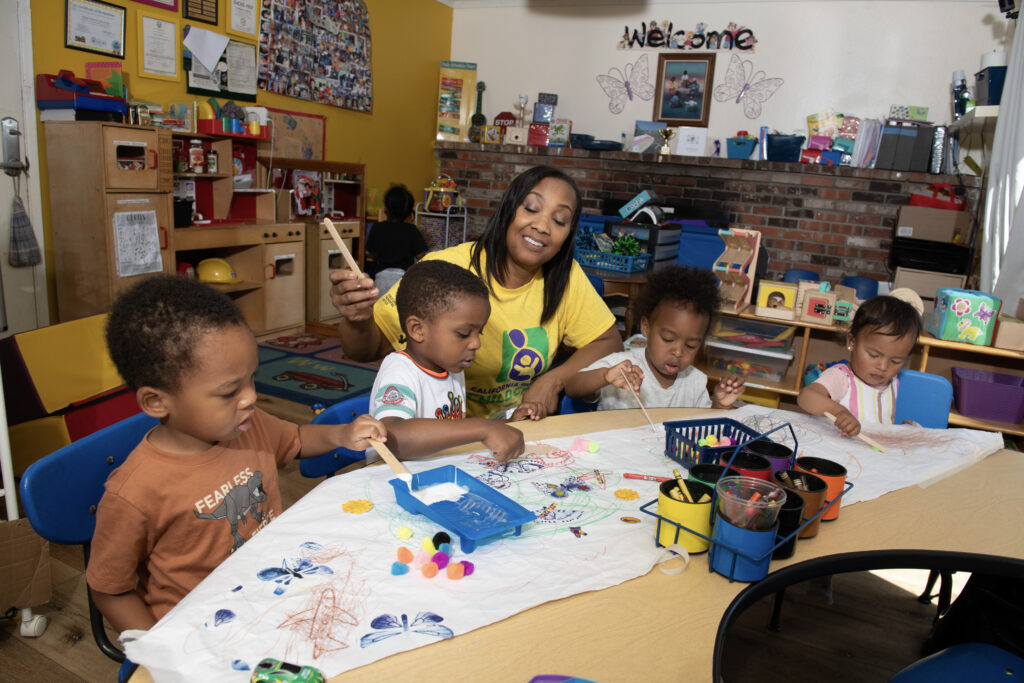

Yolanda Thomas is a 27-year family daycare and preschool provider. Her business, Best Beginnings, is based in Contra Costa County.
Credit: Child Care Providers United
Top Takeaways
- Transitional kindergarten has been gradually expanded since 2021 and is now free for all California 4-year-olds
- Childcare providers were expected to care for younger children, which comes with additional licensing and staffing requirements
- Many providers say they need far more support and funding
When one of Yolanda Thomas’ 4-year-old students left her family daycare for California’s transitional kindergarten program, she lost more than a child in her classroom. She also now had an open space that she would need to figure out how to fill.
By the time the family discovered the school day did not match their work schedules and wanted to return, another child had taken the space. Since then, Thomas has felt the need to convince parents of 4-year-olds to keep their children enrolled in her daycare and licensed preschool program, something she never had to do before.
Across California, childcare and preschool providers say similar disruptions have become increasingly common since the state’s expansion of free transitional kindergarten for all 4-year-olds, drawing students out of some existing programs while offering little support to help providers adapt.
TK is free, and that’s hard for families to pass up, but as California’s early education landscape has shifted, many providers like Thomas say they feel left behind.
In 2021, the state Legislature passed a law that gradually expanded transitional kindergarten, known as TK, into California’s newest public school grade. It made care free for all 4-year-olds, regardless of income or background, and it meant businesses like the one Thomas has run for nearly 30 years would need to adjust.
California has dramatically increased spending on early childhood education under Gov. Gavin Newsom. It nearly tripled from $5.4 billion in 2020 to $14.4 billion in 2025, according to the state’s Legislative Analyst’s Office.
The amount toward TK increased as the program reached full expansion. Childcare workers in other settings, such as home-based programs and centers that care for children from birth to age 5 have not seen the same increase in funding.
“I think from a lot of perspectives, a family moving out of paying $10 to $30,000 a year for their child’s preschool education and moving that child into TK is a good thing,” said Hanna Melnick, director of early learning policy at the Learning Policy Institute. “The loss of capacity of the provider who was teaching that child, if they’re not indeed actually going to serve younger kids who wouldn’t otherwise be in care — that’s the problem.”
Childcare workers were considered essential during the Covid-19 pandemic. Many hoped that recognition would translate into long-term investments in the childcare system and for the state to start “recognizing what we’re doing, respecting us and paying us for the work that we have done. And it is just like, now with the TK rollout, all that is forgotten,” said Thomas, who is part of the Child Care Providers United. “And now the only thing that exists is TK and that’s where all the funds and the focus is going.”
The disparity is evident in the governor’s most recent state budget proposal. The California State Preschool Program and other childcare providers that offer subsidized care would receive a 2.01% cost-of-living adjustment, while school districts — including TK programs — would receive a 4.31% adjustment.
The most recent legislative budget proposal, still to be negotiated with the governor before it’s enacted by July 1, appeared more responsive to providers’ requests. It maintains nearly 7,000 childcare slots the governor suggested eliminating while also adding almost 23,000 more spaces. There is also a proposal to move the state preschool program under Prop. 98, the state’s funding formula for education. Education groups and advocates are at odds over the idea.
“Early childhood programs have always been significantly underfunded, and it’s always been difficult to keep programs running,” said Melnick. “And so I think it was a big insult to people that different folks got the money to expand, and it’s really frustrating for completely understandable reasons.”
The missing piece of California’s TK expansion
Advocates and researchers describe universal transitional kindergarten as a significant achievement that has expanded access to free early education for California families. But many also argue that the state failed to provide comparable support to the childcare and preschool providers it expected to absorb younger children as 4-year-olds moved into TK.
The strain has become increasingly visible. A recent UC Berkeley report found a net loss of about 1,100 nonprofit preschool programs between 2019 and 2025, which researchers say can be attributed to the TK expansion.
Those closures tell only part of the story. State data shows the total number of licensed childcare facilities has largely remained flat since 2017, suggesting that many providers have stayed open.
What is clearer, advocates say, is that funding and resources have not been distributed evenly across the early childhood education sector. While TK received significant new investments, many childcare and preschool providers were left to navigate the transition with limited financial support.
“We really need to invest and help providers serve younger kids, which was the original vision,” said Patricia Lozano, executive director of Early Edge California.
When lawmakers approved universal TK, providers like Thomas were expected to pivot to serving younger children, a shift that has proven difficult.
Infant care, for example, requires more due to lower adult-to-child ratios and additional licensing requirements. Thomas said the first assistant she hired left for a fast-food job because it paid more than the minimum wage that Thomas could afford to offer. A one-time grant later allowed her to hire two assistants, but that funding expires this month, forcing her to reduce hours.
“There’s no reason why we should all have to try and scrap and save or hope and pray that our name gets picked out of this hat” to fund basic childcare costs, said Thomas.
Providers also rely on serving children across a range of ages to balance their finances. Older preschoolers help offset the higher costs of caring for infants, toddlers and children with disabilities. As more 4-year-olds move into TK, that balance can become harder to maintain.
Yet there remains a large pool of younger children who could benefit from early care. More than 306,000 California 3-year-olds were not enrolled in publicly funded early education programs in 2024-25, according to data analysis from The Learning Policy Institute. The challenge, Melnick said, is helping providers connect with those children’s families and ensuring they have the resources needed to serve them.
Advocates have proposed increasing childcare subsidies, raising reimbursement rates paid to providers and improving outreach to families about the range of early education options available.
“California has made a bigger expansion than any other state in the country, and I think we should be really proud of that,” said Melnick. But support for providers who were already serving kids to become part of that expansion — “that piece was missing in California,” she said.
Inclusion is precisely the change Thomas and other providers say they are still waiting to see.
“We would like our experience to count for something,” said Thomas. “There has to be a pathway where we can use our years of experience. It has to be something substantial that is part of this TK rollout.”
Unsorted,Child Care,Child Care Providers United,early education,Gov. Gavin Newsom,Transitional Kindergarten#Californias #childcare #preschool #providers #struggle #transitional #kindergarten #expansion1781685803

