

 wellnessfitpro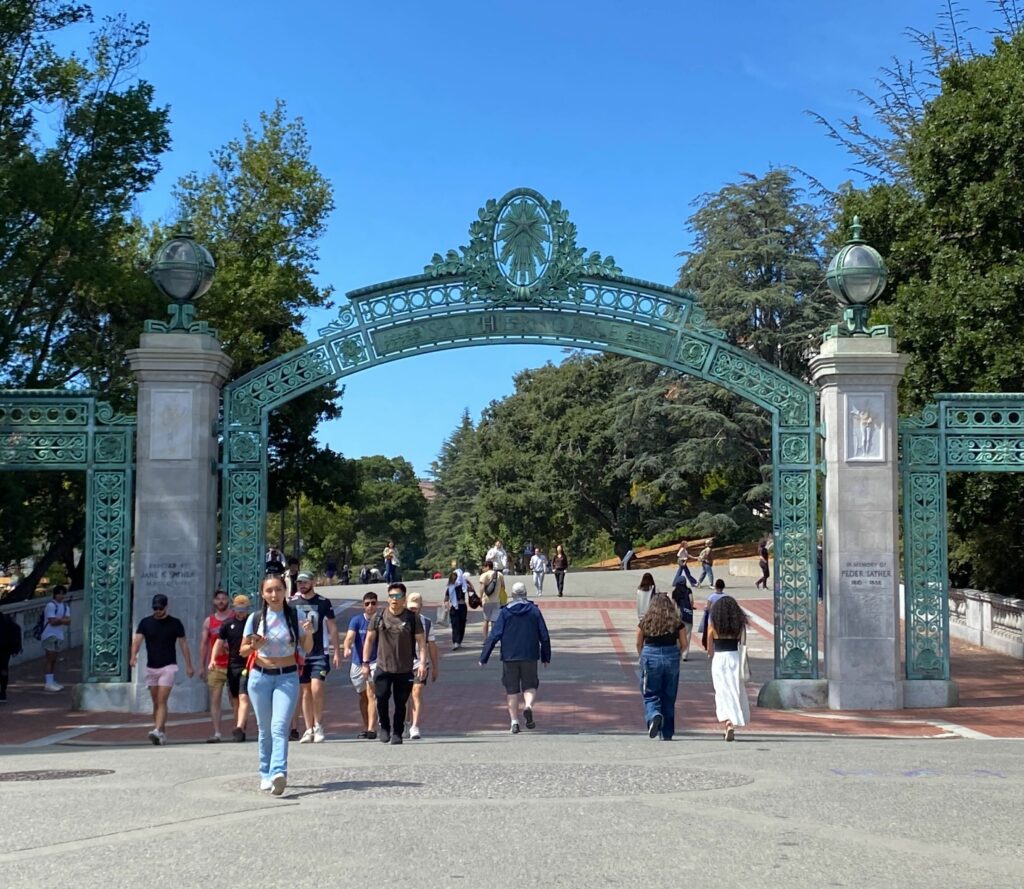

UC Berkeley Sather Gate.
Credit: Corinne Davidson / EdSource
After the first few years at a university, students groan at the thought of advanced degrees — master’s or Ph.D. programs — that would ensure another two to seven years of hitting the books and sitting in lecture halls or lab spaces. Ask a younger undergraduate during finals week if they’d consider applying to graduate school, and you’re more likely than not to be met with an emphatic “no!”
Now, try asking a graduating senior of the class of 2026 if they’re considering more school, and you’re more likely to hear a wavering “yes.”
One can’t blame them. In the face of a shaky economy with unemployment rising to 4.4% in February, it seems like common sense to delay the inevitable while gaining an edge in the bottomless pit that is the job market.
And yet, finances cannot be ignored. With the One Big Beautiful Bill Act (OBBB) signed into law in July 2025, those seeking graduate degrees are left at a serious disadvantage as the loan landscape grows dim.
Personally, I fall into both categories above: A graduating senior who is pursuing job opportunities while also weighing graduate school. The decision has me — and other graduating seniors — wondering: For those who can afford it, do graduate programs act as a security blanket? Or do they really provide an innovative edge to cope with an uncertain future?
I asked several students about this.
At UC Berkeley, fourth-year media studies major Danielle Frank will attend Columbia University in the fall for a Master of Science in Sustainability Management. This decision, she said, is largely motivated by a desire to gain technical skills and difficulty in breaking into what could be categorized as “entry-level” jobs. “I don’t even know what entry-level job I would apply to,” Frank said. “I really don’t know where my space is or what job I would even excel at. I feel as though I need more skills and more time.”
Chloe Leaver, working to complete her bachelor’s in urban studies with a minor in sustainable design from UC Berkeley this spring, has applied to master’s programs across the country for regional and urban planning. She agrees with Frank’s perception of her career landscape. “I think that I have a lot of qualifications, but … I do believe that it is just more competitive.”
This perception is heightened by the latest employment news, which reports that hiring tanked in February as employers cut around 92,000 jobs.
And the repeated maxim that AI is coming for all manner of jobs adds to the stress. Articles touting the end — “See which jobs are most threatened by AI and who may be able to adapt” — are everywhere. Leaver admits that it’s easier to apply to jobs now, but “it’s also easier to use AI to just scan out a lot of applicants.”
Class of 2025 UC Berkeley graduate Elena Ramos said of her choice to apply to graduate schools for city and regional planning: “From what I’ve looked at online, it seems like most careers in city planning, even entry-level, you would need a master’s.”
Nadia Dickey, a 2025 graduate from UC Berkeley applying for master’s programs across the country and abroad in urban planning and social policy, said, “Most of the jobs that I would be applying for need a master’s, and part of the reason that I wanted to … do it right after is because I know I have to do it anyway.” She also said the job market is particularly unstable for global development and global aid.
Obviously, the cost of graduate school can’t be ignored. Leaver, Ramos, Dickey and Frank are fortunate to have support systems to help them finance their degrees. Ramos benefits from her dad’s CalVet tuition waiver, while Leaver, Dickey and Frank have families who will help cover part of the cost of their advanced degrees.
For students who don’t have this support, scholarships and financial aid are available. However, a condition in the Trump tax and finance bill is that unsubsidized direct loans for professional programs (medicine and law) are capped at $50,000 a year; all other graduate programs are capped at $20,500/year.
Lauren Halbrook, a 2025 UC Berkeley graduate, will attend the University of Oxford for a master’s in English, with a specialization in literature from 1700 to 1830. The decision to study abroad is, in large part, influenced by finances.
“School is just cheaper in the U.K.,” Halbrook said. “I’m still gonna have to take out loans, so I’m doing loans through FAFSA and then applying to some scholarships and hoping for the best.” She is also saving money, working and living at home “really frugally.”
In December, I submitted an application to a one-year master’s program starting in fall 2027. For all the reasons I’ve cited above, it was an application that served more as a “backup option” than a viable plan — a “just in case.” But on March 13, I received a status update email from that program: on-screen confetti, “Congratulations” and a financial package that let me know I might be able to accept the confetti and congratulations.
As I weigh a financially feasible graduate school education versus 2026’s entry-level job market, the decision seems obvious. But like most graduating seniors considering grad school seem to know, it isn’t. I’m also weighing a return on investment, the entry-level job landscape with and without a master’s degree and the feasibility of combining loans, scholarships and a frugal lifestyle. Having said that, the idea of graduation feels a little less scary knowing I have a realistic option for the future.
•••
Stella Occhialini is a fourth-year student at UC Berkeley studying English and anthropology, and a member of EdSource’s California Student Journalism Corps.
The opinions expressed in this commentary represent those of the author. EdSource welcomes commentaries representing diverse points of view. If you would like to submit a commentary, please review our guidelines and contact us at commentary@edsource.org.
Unsorted,California State University (CSU),University of California (UC)#grad #school #gap #year #lackluster #job #market1776765253

