

 wellnessfitpro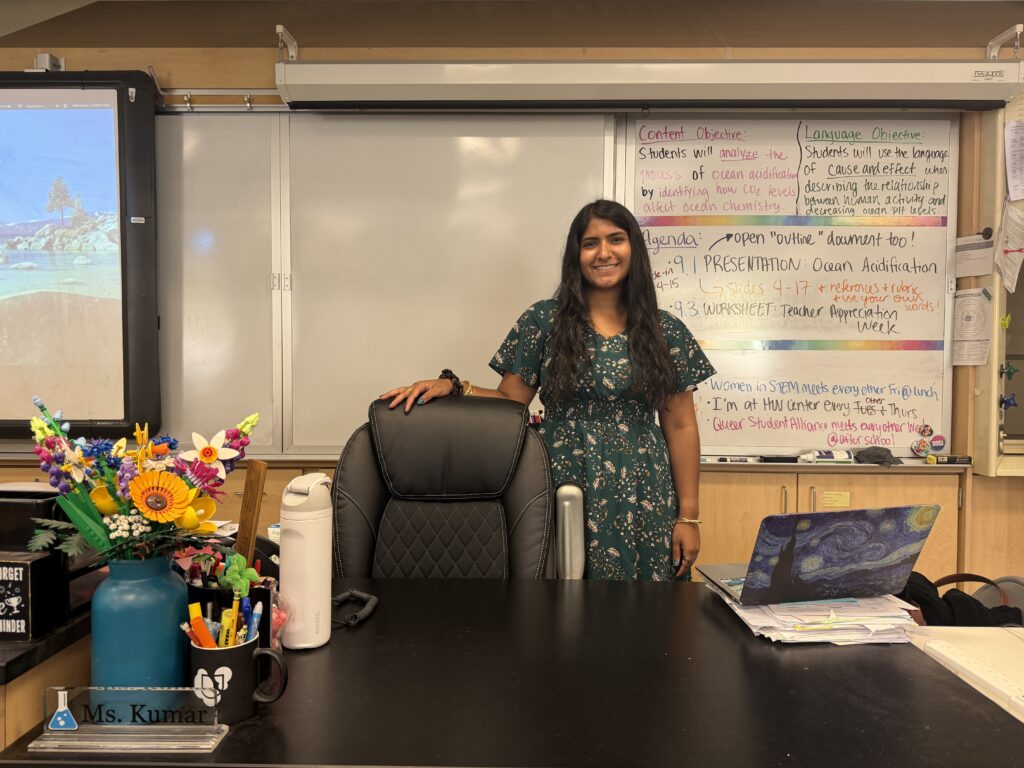

Teacher Anjali Kumar in her classroom.
Courtesy: Anjali Kumar
On the first day of school, I ask my students to introduce themselves. It’s a simple routine. Say your name, something about yourself, and maybe what you’re excited or nervous about for the year. When it was Emilio’s turn, he froze. He had arrived from Colombia a few weeks earlier. After a long pause, he said, “Emilio,” barely above a whisper. Then he stopped. He didn’t know how to introduce himself in English.
In that moment, it hit me. Something that felt basic to me was completely inaccessible to him. And I wasn’t fully prepared to support him yet.
California has laid out a strong vision for supporting multilingual learners through the English Learner Roadmap, a tool that shows educators how to support and prepare English learners, also referred to as multilingual learners, with the necessary skills for their futures.
The challenge is that too many teachers are left without enough training or support to turn this policy into practice. Our newcomer students, like Emilio, were spread out among my 10th-grade chemistry classes. I had taught English learners before, but newcomer students require different support, which includes building their basic communication and conversation skills. At the time, when I asked for guidance, there wasn’t much to go on. My district provided student data on English proficiency, as well as some professional development opportunities. Still, it took a while for me to have the STEM-specific resources and actionable tools I needed. I was expected to teach rigorous chemistry in English without a clear model for how to make that content accessible to Emilio. At times, it felt like I was set up to fail.
So I had to figure it out for myself. Over the next few months, I used hands-on lab experiments so Emilio could experience the science before explaining it in English. I relied on visuals, card sorts and modeling to connect vocabulary to meaning, and paired him with bilingual classmates so he could practice speaking in low-pressure ways.
Slowly, Emilio started participating, taking risks. By the end of the semester, Emilio could explain his thinking in class. Not perfectly, but more confidently. As I was learning how to support him, my school was learning too. These are all strategies teachers can learn, but there was no system in place to ensure I had the training to support a student like him.
I didn’t learn about the English Learner Roadmap until my fifth year of teaching. The Educator Workforce Investment Grant (EWIG) program is intended to close staffing gaps to support multilingual learners and provide professional development for teachers. Earlier rounds of this grant funding focused on building county-level capacity. As the governor prepares to release his revised budget proposal by May 15, we’re at a turning point. Educator Workforce Investment Grant funding was not included in the governor’s proposed January budget, putting this progress and the resources that students like Emilio need for success at risk. If we’re serious about supporting multilingual learners, we can’t afford to lose one of the few programs designed to turn policy into practice.
First, California should continue this grant funding so that more teachers can access high-quality training to support multilingual learners like Emilio. Without sustained funding, progress will stall before the resources reach the students who need them most.
Second, that training needs to be ongoing and built into teachers’ daily work. Teachers need embedded support, including coaching, collaboration time and opportunities to apply strategies in real classrooms. For example, Monday afternoons at my school, which are generally left open for our staff meetings, could be utilized for professional development on the English Learner Roadmap.
Third, we need to ensure these resources actually reach classrooms, not just remain at the county or administrative level. Funding should result in direct, visible support for teachers, not just plans and frameworks that never make it into instruction. For example, I could have benefited from having instructional coaches model strategies in my classroom for building multilingual learners’ basic communication skills.
Strong policy doesn’t automatically lead to strong instruction. My biggest realization wasn’t just that Emilio needed support. It was that I needed support to support him.
By the end of the year, Emilio could introduce himself. He could share his ideas. He could participate in class. That didn’t happen by chance. It happened because he had support. Students like Emilio should not have to depend on whether their teacher has the time, energy, or background to build that support from scratch. They should be supported in every classroom, from day one.
California already has the vision. Now the question is whether we’re willing to invest in making it real.
Note: The student’s name has been changed to protect their privacy.
•••
Anjali Sara Kumar is a 10th grade chemistry teacher in San Jose and a 2025-26 Teach Plus California Policy Fellow.
The opinions expressed in this commentary are those of the author. EdSource welcomes commentaries representing diverse points of view. If you would like to submit a commentary, please review our guidelines and contact us at commentary@edsource.org.
Commentary,English learners,Gov. Gavin Newsom,Languages,State Budget,Unsorted,2026-27 State Budget,Educator Workforce Investment Grant,Newcomer programs,Teach Plus#Supporting #multilingual #learners #means #supporting #teachers1778223071

