

 wellnessfitpro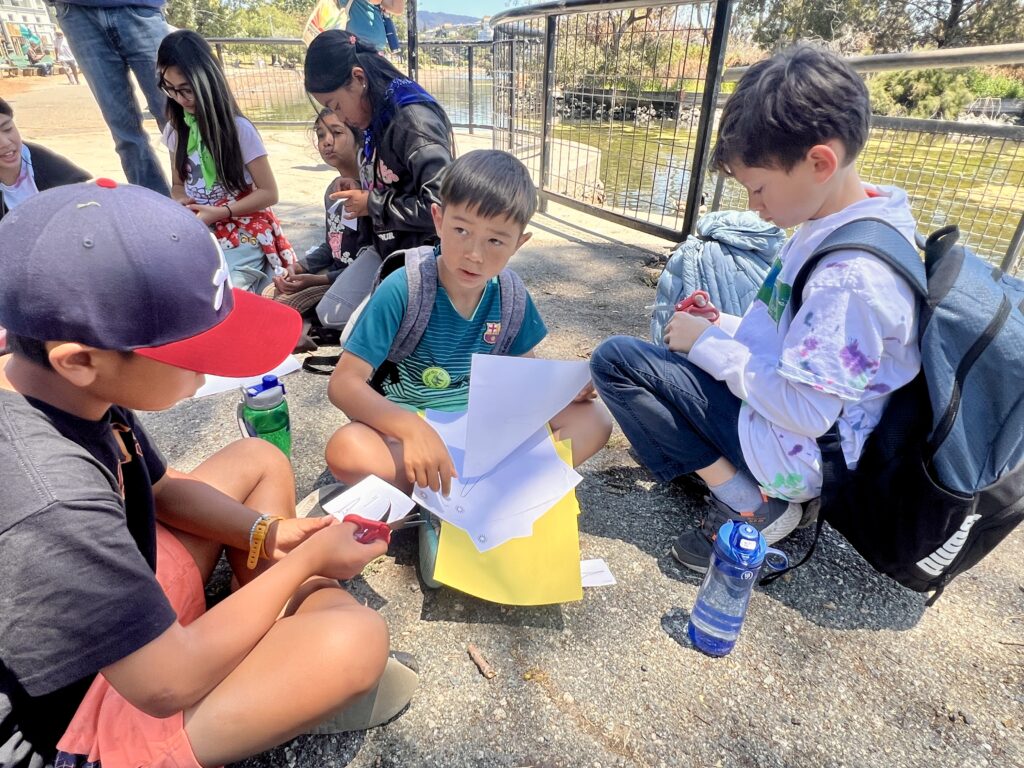

Richmond students enrolled in the Headwaters Science Institute’s summer program make cutout paper models of birds on the banks of Lake Merritt in Oakland.
Credit: Louis Freedberg / EdSource
When I was teaching middle school science and later working as an administrator, I bought into the belief that a teacher should be a “guide on the side,” not a “sage on the stage.” Like many educators, I championed project-based science. Looking back, I realized I should have balanced those “minds-on” projects with more direct instruction. After all, children are not going to discover Newton’s laws of motion or Darwin’s theory of evolution on their own. Those ideas must be taught.
In California, only 34% of students met or exceeded standards on the 2024-25 statewide science test. Persistent disparities remain, with African American, Latino, American Indian, and economically disadvantaged students overrepresented in the “standard not met” category. Could an imbalance between too much project-based learning and too little direct instruction be part of the reason?
Project-based science invites students to investigate authentic, real-world problems through inquiry.
- Advantages: promotes engagement, deeper understanding, and 21st-century collaboration skills.
- Disadvantages: resource-intensive, requires expert teacher preparation, and complicates assessment.
Take an inquiry question such as, “Is it raining on Mars today?” Instead of being told, students might explore Mars in real time. They discover that while it does not rain liquid water, Mars can experience carbon-dioxide frost or snow. Students create models to explain why this happens and even produce a two-minute “Live Weather Feed” from the Martian surface. The teacher’s role is to guide students’ inquiry, ensuring curiosity turns into scientific reasoning, rather than learning through rote memorization. This is student-driven learning anchored in wonder.
Direct instruction, by contrast, is a structured, teacher-led method built on explicit, step-by-step teaching.
- Advantages: efficient, ensures mastery, and benefits at-risk learners.
- Disadvantages: can feel repetitive and limit autonomy.
Using the same Mars example, the direct instruction approach begins with firm teacher control. The clear objective: Students will identify the state of water on Mars and explain why liquid rain cannot occur. The teacher dramatically opens an umbrella and asks, “If I were standing on Mars today, would this be my most valuable tool or a waste of space?” She then explains that low pressure and temperature make rain impossible. In guided practice, students complete a T-chart comparing Earth and Mars. The teacher elicits conclusions, then assigns an exit ticket: “Imagine a NASA scientist finds a cloud on Mars. Why won’t they pack a raincoat?” Here, learning is led, modeled and checked for understanding — knowledge is transmitted with precision.
The tension between these approaches is addressed in the Next Generation Science Standards (NGSS), which integrate core ideas with science and engineering practices and inquiry. California adopted the standards in 2013, with 78% of districts reporting implementation in 2017. However, the implementation is uneven, with low-income and low-performing districts reporting less knowledge of the standards.
Without systematic implementation support, it will be mostly affluent districts that realize the potential of project-based science. The teaching approach requires increased costs for kits with annual replenishment, digital simulations and labs, and professional development. Less economically advantaged school districts will find it challenging to implement project-based science with quality and rigor. Artificial intelligence may be able to bridge the gap by providing inexpensive alternatives to expensive instructional resource support.
Science itself often ends up on the back burner. During pandemic recovery, only 27% of districts prioritized science, compared with 80% for English or math. Just 17-20% of K–3 classrooms teach science most days.
Nevertheless, there is reason for optimism. WestEd studied eight California districts and two charter schools — including Oakland and San Diego Unified — and found that NGSS-aligned instruction improved engagement and boosted performance in math and English. In these “early implementer” districts, science served as a catalyst for argumentation and academic language.
So, what should teachers do? Experience and research point to the need for balance. Begin with mini-lessons (direct instruction) that build knowledge of Mars’ atmosphere, temperature and pressure. Students demonstrate mastery through teacher-led drills or fact sheets. Then, teachers shift to inquiry, in which student teams design models of a future Mars capable of producing liquid rain by 2100. In these “terraforming” teams, students apply scientific principles creatively — project-based science built upon a foundation of clear instruction.
In this blend, direct instruction provides the facts; project-based science transforms those facts into applied understanding. Students learn not only why Mars is dry now (a fact from direct instruction), but also how science could someday make it rain (a project-based discovery).
Working with the Alameda County Office of Education on a National Science Foundation grant, I saw this synergy firsthand: Professors delivered rigorous lectures while we helped teachers craft inquiry-driven projects. When done well, projects became intellectually rich, not poster-board busywork. The most vibrant classrooms treated direct instruction and project-based science not as rivals but as partners.
Direct instruction gives students a map; project-based science offers the journey. Together, they ensure students not only learn the laws of science but also gain the agency to apply them.
•••
Bill Conrad has been an educator for over 47 years, and he has worked extensively within school districts throughout the country in a wide variety of capacities, including as an honors middle school science teacher and administrator.
The opinions expressed in this commentary represent those of the author. EdSource welcomes commentaries representing diverse points of view. If you would like to submit a commentary, please review our guidelines and contact us.
Commentary,Standards,State and Federal Policies,Unsorted,Next Generation Science Standards (NGSS),WestEd#balance #direct #instruction #projectbased #science1778568337

