

 wellnessfitpro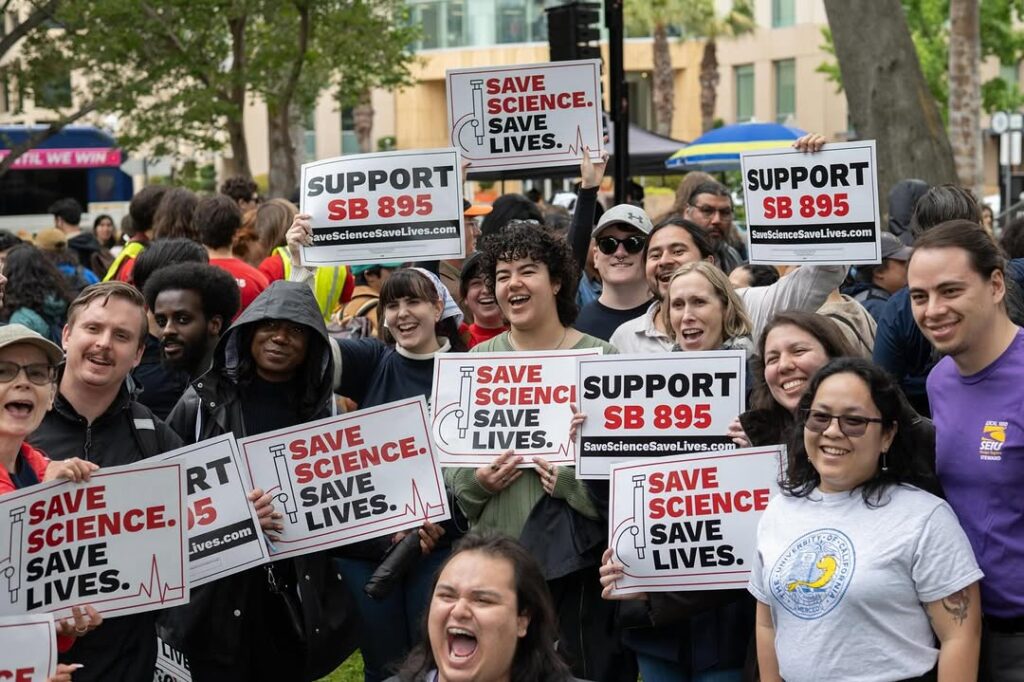
Top Takeaways
- The Trump administration has awarded fewer grants toward scientific research or eliminated them altogether, impacting researchers at several California universities.
- In response, the University of California is pushing to get a $12 billion state bond on the November ballot to fund scientific research at California universities, research institutes and private companies.
- For the bond to appear on the ballot, the state Legislature first needs to approve Senate Bill 895, which is supported by the union representing academic workers at UC.
David Boyer is stuck in a waiting game. For more than 18 months, silence from the National Institutes of Health on a crucial grant decision has thrown his research developing treatments for Alzheimer’s disease into uncertain territory.
His application received a favorable impact score, the main metric used for NIH funding decisions, so the postdoctoral scholar at UCLA figured he would hear good news by spring of 2025. Instead, he has heard nothing.
David Boyer, a postdoctoral scholar in UCLA’s Eisenberg Lab
Without the funding, he has less to spend on his experiments, which require thousands of dollars worth of materials, including advanced microscopes. In a worst-case scenario, it’s possible he could lose his job if the grant doesn’t come through.
“It’s really up in the air whether I would be able to continue getting funded,” said Boyer, who is part of UCLA’s Eisenberg Lab.
Boyer is not alone. Federal funding for scientific research, from agencies such as NIH and the National Science Foundation, has been upended under the Trump administration, with fewer grants being awarded and some existing grants being canceled altogether. Even researchers with stable funding worry that their grants could get suspended or will not be renewed.
But now, Boyer and other researchers at California universities have some hope that they could get a reprieve — from California voters.
The University of California is pushing to get a $12 billion state bond on the November ballot that would fund scientific research projects at California universities, research institutes and private companies. In addition to UC and California State University campuses, private universities such as Stanford and the University of Southern California would also be eligible for the bond money.
For the bond to appear on the ballot, the state Legislature first needs to approve Senate Bill 895. The bill’s sponsors include UC and UAW 4811, the union representing 48,000 academic workers at UC, including thousands of researchers.
The bill was approved last week by the Senate and now heads to the Assembly. It must be passed and signed by Gov. Gavin Newsom by June 25 to make the ballot.
“As the federal government cuts and destroys scientific funding, as it creates long-term instability and uncertainty, as science has now become a political football in this country, let’s make sure that California retains and expands our leadership in scientific research,” state Sen. Scott Wiener, D-San Francisco, said on the Senate floor last week just before the vote. Wiener is one of the authors of the bill.
If passed and approved by voters, the measure would create the California Foundation for Science and Health Research, which would award the grants using “an open, competitive, scientific peer review process,” according to the bill.
The bond would not be a cure-all for research funding if federal spending continues to dwindle. UC alone gets nearly $6 billion annually in federal support for research.
“There is nobody else who can substitute for research funding on the scale the federal government supplies,” said Simon Atkinson, vice chancellor for research at UC Davis.
Still, Atkinson and other proponents of the bond agree that it would benefit researchers in California not to rely so much on the federal government, especially under the Trump administration, which proposed a $5 billion cut to NIH for 2027. Last week, The New York Times reported that NSF had slowed funding to Harvard and other institutions targeted by the White House, though the impact on California campuses is unclear.
Having another potential funding source would be welcome news to Ximena Anleu Gil, a plant biologist at UC Davis who researches how to breed more plants in environmentally friendly ways.
Related Reading
Federal grant cuts hit California universities hard, putting research in limbo
May 28, 2025
There is one year remaining on the grant that funds Gil’s position in UC Davis’ Meyers Lab. The prospect of not having the funding renewed is stressful for Gil, who is the main provider for her family, which includes her partner and 7-month-old daughter.
“I’m very scared of what could happen. If I’m laid off, we’re screwed,” Gil said. “But having another source of potential funding, that would already feel like a big relief.”
If voters approve the bond, the legislation requires that priority be given to replacing funding slashed by the federal government.
In California, 782 grants have been terminated by the federal government since January 2025, according to the website Grant Witness, a project tracking terminations under the Trump administration.
Most of those grants have been restored under court orders, but dozens remain canceled, including one at UC San Francisco’s Center for AIDS Research that paid for training for undergraduate students.
Under that grant, students from nearby Hispanic-Serving Institutions, including San Francisco State University, would spend the summer at UCSF doing HIV research. At the end of the summer, the center would hold a symposium where undergraduates present their findings.
The idea was to expose those students to the field and get them interested in HIV research, said Monica Gandhi, director of the center.
“There are fewer and fewer people going into infectious disease research at a time when infectious diseases are all over,” Gandhi said. “It really just got them excited, and we thought it would help grow our biomedical research workforce in a really important topic.”
If California’s bond goes through, Gandhi said she expects the center would immediately apply for a grant to restart that program.
Federal funding remains intact for the rest of the AIDS research center, which organizes all HIV research across UCSF. But it’s not clear how long that will be the case. Gandhi said the center is waiting for a formal notice from NIH to apply for a grant renewal, which she said normally would have come by now.
“There are all these little ways they are making it harder to get funding,” she said. “Having a California-based initiative that isn’t political and will have the grants be judged on their scientific merit would be amazing. And I think it will go a long way.”
EdSource is dedicated to covering in California and nationally. Other publications may republish EdSource articles, online or in print, at no charge, provided adherence to our guidelines. The embed code provided here includes a tracking pixel to enable us to measure the reach of our stories. It must be included in any online pickup of EdSource stories.
The following guidelines apply to all EdSource content, including stories, podcasts and video:
Editing stories: Trimming stories for length or adding additional localized reporting is allowed. However, if you wish to make material edits, please contact EdSource for approval prior to publication. Please reach out to Andrew and Smita at republish@edsource.org with questions.
Crediting EdSource: Authors and EdSource should be credited in the byline with a link back to the original article. (This is in the embed code. Please be sure to include it.)
Monetization: EdSource stories cannot be sold, but it’s OK to put EdSource articles on pages with ads.
Photos and graphics: Assets such as photos and graphics must be added manually. Photos taken by EdSource staff may be republished, but some images, such as those from third-party providers (Associated Press, iStock), may not be republished without permission or payment. Proceed with caution. You may also run your own photos with the EdSource story. On occasion, EdSource editors may be able to provide partners with embed codes for graphics or localized data. If you have questions, please contact us.
RSS Feeds: News organizations cannot systematically republish all EdSource articles via RSS feed or other mechanism.
Unsorted,SB 895,Trump administration,UC Davis,UCLA,UCSF#University #California #pushes #12B #scientific #research #bond #counter #federal #cuts1780645196

