

 wellnessfitpro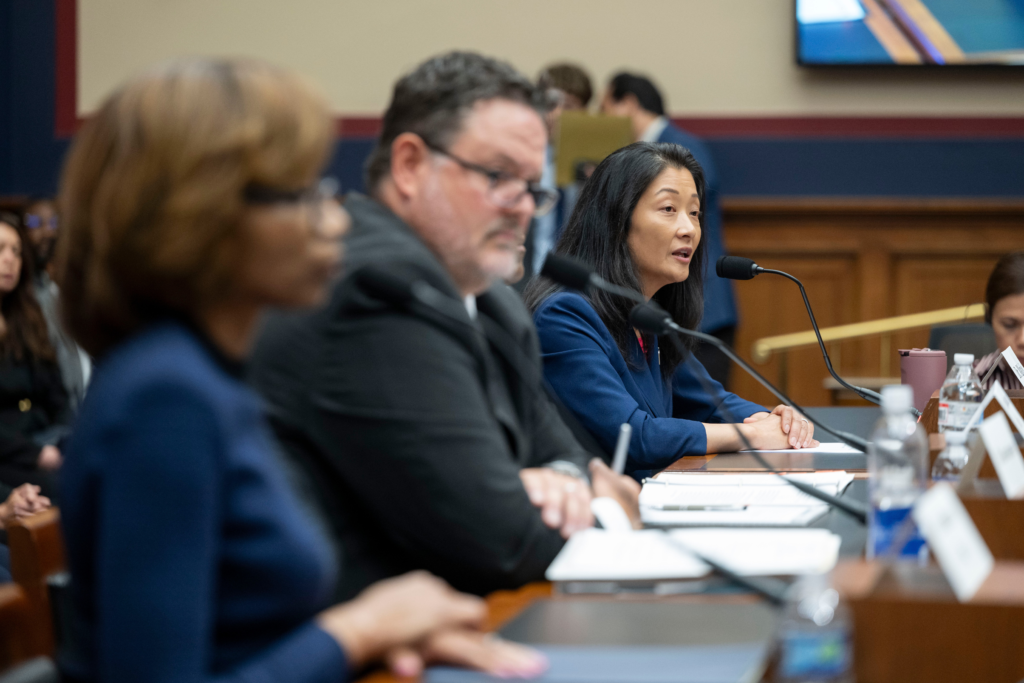
Top Takeaways
- Republicans drew attention to high-profile cases of sharing locker rooms with transgender students at a Wednesday congressional hearing.
- House members questioned San Francisco Unified Superintendent Maria Su and leaders of school districts in Chicago and Loudoun County, Virginia.
- Su was unapologetic about the district’s commitment to equity and diversity in response to House Republicans’ questions.
Republicans unleashed attacks on what they characterized as radical gender and anti-parent approaches in school districts during a highly charged, partisan-divided congressional hearing on Wednesday.
The hearing gave House Republicans, facing a possible electoral loss in November, a stage for a flashpoint cultural issue popular with conservatives and, they believe, the public at large. San Francisco Unified Superintendent Maria Su, one of three superintendents on the panel, however, may not have provided the fat target Republican leaders had anticipated.
“When classrooms become vehicles for political or ideological agendas, rather than places of learning what students need to learn to compete in this world, Congress has a responsibility to ask questions,” said Rep. Tim Walberg, R-Michigan, chair of the House Education and the Workforce Committee, in kicking off the hearing. “And so this is exactly why we are here today,”
Meanwhile, Democrats questioned the need and purpose of the hearing, which some characterized as a deliberate diversion from issues that most parents consider important.
“This committee is spending time hauling you (superintendents) before Congress to answer for your diversity programs while we’ve had zero hearings on chronic absenteeism, zero hearings on the mental health crisis that we’re facing, no hearings on how we can infuse the teacher pipelines so that you have the qualified educators,” said Rep. Jahana Hayes, D-Connecticut, a former teacher.
On Monday, the U.S. Department of Education announced that San Francisco Unified was one of four California districts that will be subject to a federal “compliance review” of its gender and sexual orientation policies.
This will include whether the district is complying with two federal court decisions. One decision, Mahmoud v. Taylor, gives parents the right to opt out of LGBTQ discussions and curriculums that conflict with their religious beliefs. In the other, Mirabelli v. Bonta, the U.S. Supreme Court has temporarily blocked a California state policy advising districts not to inform parents of their children’s gender transitions in school.
House members questioned Su and the others about their compliance with the court decisions, but did not bring up the new federal investigation of San Francisco Unified.
Su was unapologetic about the district’s commitment to equity and diversity.
“The city is known as a pioneer in LGBTQ rights,” she said. “We were one of the first to recognize the importance of teaching about our diversity so that students can learn and grow together. Students need safe and welcoming schools and teachers need support.”
At the same time, she escaped the harshest criticism directed at Aaron Spence, superintendent of Loudoun County Public Schools in Virginia, and Macquline King, superintendent and CEO of Chicago Public Schools.
Su, who has been superintendent for only 1 1/2 years, deflected criticism with careful, disarming answers.
Rep. Glenn Grothman, R-Wisconsin, asked Su to define “white supremacy culture,” a concept he said he found in a professional development document for the district’s ethnic studies program.
“I don’t know anybody who believes that. But the fact that you have it out there in the San Francisco schools implies you think there’s such a thing as white supremacy culture,” he said. “Do you believe it? Is it a problem in San Francisco?”
“The incident that you’re referring to happened before my time as a superintendent,” she replied. During her 18 months as superintendent, she said, “I’ve spent my time focused on serving the 49,000 students that we serve.“
Rep. Burgess Owens, a Utah Republican, questioned a reference he said was in the district’s revised ethnic studies material that compares parents’ protests over Covid policies to white parents’ flight to private schools in the 1960s to avoid desegregation policies.
“Thank you for that question. I’m sorry. Do you have the example that you’re reading from? Can I see, can I see the document?” Answered Su.
“I don’t have the document. Do you agree with that statement though?” Owens persisted.
“I would need to see the document so I can speak,” she replied.
Su also wasn’t subjected to the type of disparaging remarks directed to the others. Frustrated by Spence’s refusal to discuss disciplinary action against a Loudoun County transgender student who filmed students in a locker room, Rep. Lisa McClain, a Republican from Michigan, said his response was “pathetic.”
Rep. Mary Miller, R-Illinois, criticized King of Chicago Public Schools for, unlike Spence and Su, requiring the committee to subpoena her testimony following “vague and evasive excuses.”
“Transparency and accountability should not require a subpoena,” she said. Chicago Public Schools “is far more interested in sidelining parents and promoting radical gender ideologies than ensuring students can read, write and perform math at grade level,” Miller said.
In contrast, two California committee members, Mark DeSaulnier, D-Concord, and Kevin Kiley, R-Rocklin, commended changes Su has made in her short time on the job after listening to parents and the community. They credited her for reinstalling algebra in eighth grade, revising and somewhat tempering the district’s long-standing and controversial ethnic studies requirement, scrapping the former school board’s effort, amid Covid, to change schools named after Dianne Feinstein and Abraham Lincoln, and restoring fiscal stability to the district.
“I’ve been pretty critical of San Francisco Unified in the past, but I actually think there’s been some encouraging changes lately, and you’re relatively new to your role,” said Kiley, who faces a tough reelection in a newly gerrymandered district.
Much of the Republicans’ attention — and ire — was on Loudoun County’s and Chicago’s handling of transgender students. Spence was pressed about accusations of disproportionate discipline involving a transgender girl who assaulted a girl in a locker room. He refused to discuss details.
Walberg and others centered on Chicago Public’s policies.
“Third grade material then asks students to, and I quote, explain the difference between sex assigned at birth and gender identity. By fifth grade, CPS introduces students to puberty blockers,” Walberg said. “Chicago’s policy even allows biological males on a case-by-case basis to sleep with biological females on overnight field trips. So does Loudoun County.”
The superintendents said their districts comply with local, state and binding federal laws and accommodate parents’ concerns.
“This is a huge national issue,” Miller responded. “This is a bipartisan issue. Americans do not want males, boys, or men in the girls’ private spaces or their athletics.”
Added Walberg, “Bottom line, this was an important hearing, an emotional hearing, of course, but this is part of education, and parents should not be seen as entities to be managed if, indeed what you said today is true, that parents are integral to the success of your educational experience.”
Unsorted,House Republicans,Kevin Kiley,Mahmoud v. Taylor,Maria Su,San Francisco Unified School District,Tim Walberg,Transgender students,U.S. Department of Education#Congressional #Republicans #grill #unfazed #San #Francisco #superintendent #gender #policies1781153531

