

 wellnessfitpro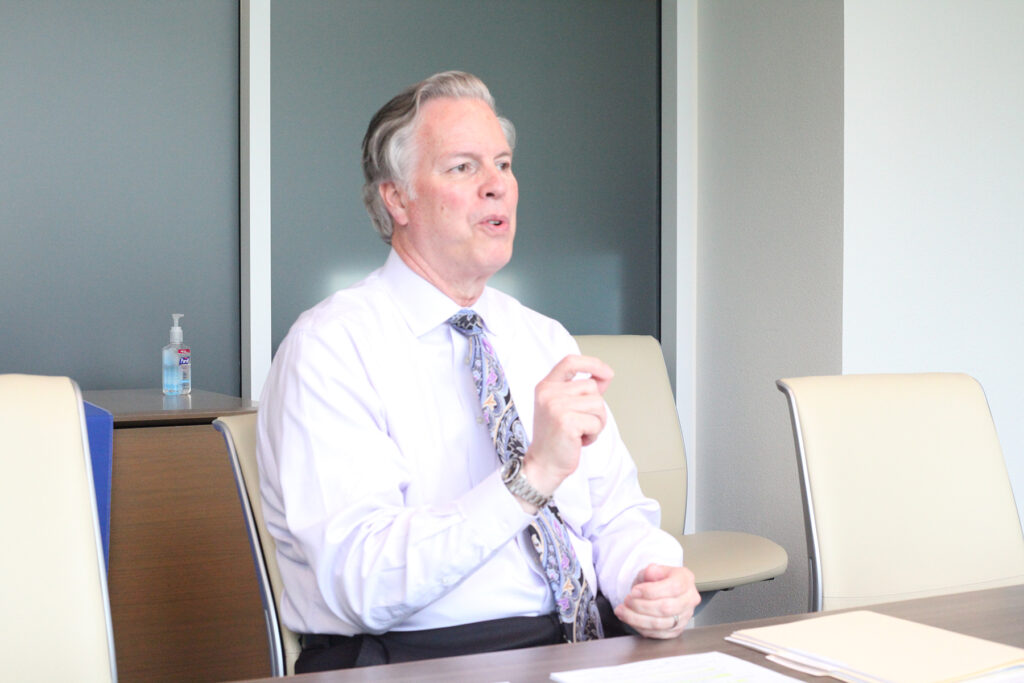

Sonoma State president Michael E. Spagna
Ashley Metzger
The past several years have been turbulent for Sonoma State, with a revolving door of presidents, declining attendance numbers and last year’s elimination of dozens of degree programs and its NCAA sports amid major budget cuts.
But when Michael E. Spagna was hired in January — he’s been in the California State University system for 35 years, most recently at Cal Poly Humboldt, where he’d been serving as interim president — the campus community saw its first glimmer of hope in a long while.
Spagna, who prefers being called “Mike” by students, has big expectations to live up to in bringing Sonoma State to its former glory. He believes that the combination of the pandemic and a prevailing question among high school graduates asking “Why should I go to college, what’s it going to do for me?” added to Sonoma State’s enrollment issues.
He noted that turnover at the president’s level — Sonoma State has had six presidents in the past decade — “creates a level of instability at the institution. So I wanted to come and provide stability. … In my career, I’ve always had longer stints, so I knew that if I came here, I could try and give some support,” he said, adding that he plans to stay for several years.
Spagna sat down with California Student Journalism Corps reporter Brett Tatge in early April to discuss the administration’s plans for admissions, concerns about cuts to majors and athletic programs and how community and diversity play a major role in a healthy university.
This interview was edited for length and clarity.
What were your initial thoughts when you arrived at Sonoma State?
I knew that with all the challenges that happened with closing athletics and other programs, I was coming to a university where morale was going to be notably low. My first thought was I had to be as engaging as possible, and try to give some semblance of hope … so that we could start reenvisioning and rebuilding the campus.
I didn’t expect the warm welcome I got from everybody at the university and the community. It’s been very heartwarming.
Since you’ve arrived here, you’ve established a connection with students and faculty, including maintaining a social media presence and regularly attending events. What inspired you to be more involved in student life?
This goes to the core of why I’m even in higher education. I was a former middle school teacher, and that experience made me understand how, at the end of the day, it’s all about the students. When you’re a middle school teacher, they’re all yours — you’ve got to make sure they’re successful, especially for students who feel they’re less than others, like those who have disabilities or have been emotionally beaten up. And to do that, you’ve got to use your brain, you’ve got to use humor, you’ve got to let people in and be yourself.
So, to that end, I love being with the students. You don’t want leadership that’s unapproachable, because your work is really about supporting others. And it’s not hard, you just need to be engaged and have fun.
What are your plans for increasing enrollment numbers?
I knew that an enrollment strategy here would have to be based on several things that were state of the art and best practices. (Some) ideas the (previous enrollment) team were already working on include what we call “guaranteed admission,” which is direct admission. The idea is to not put the burden on students to have to apply. (This) means if you have a certain GPA, and your school district has an MOU (memorandum of understanding) with the university, we will give you a letter saying you’ve been admitted to the university. There’s a big difference between saying you’ve automatically been admitted to the university versus you having to wait and see.
A second thing we want to do is open up pipelines in the state. I learned this when I was at Cal Poly Humboldt because I found there (that) 20% of their student body comes from Southern California and the Central Coast. Sonoma State had this pipeline originally, like when it was at its height and reached 9,500 headcounts. So those need to be reestablished, and we’ve hired recruiters in the San Diego area, Los Angeles and the Central Coast, talking about why Sonoma State is such a phenomenal place to come for college.
A third strategy is going out to schools. I’ve been to several high schools now, showing up as the president, saying ‘Look, we’d love to have you here!’ This is important in the region, at our local schools, because parents want to know that they’re sending their sons and daughters to a place that cares about them, and it means a lot to have the president show up and say, ‘I’m here, and I want to assist you in this process.’
The fourth strategy is we have to get very sophisticated about making sure students have paid internships and jobs as soon as they get here. We have to start early on with what we’re doing with students, the first year they get here.
Also, dual enrollment, the idea that we are enrolling students in schools that are taking college credit, and can get experience in college where it’s not so overwhelming. It builds resilience so that when you come as a first-year student, it’s like, ‘OK, I know it’s going to be hard, but I have some experience.’
Those five strategies are things that we are actively using right now at the university, studying which one has a better return on investment. We don’t know yet which is going to bear the most students. I think it’s probably a combination of all five.
What are your thoughts on the place of athletics for a university? Do you see a way for athletic programs to return, and if so, which ones?
I’m gonna be on the fence a little bit about which ones. I know that from the NCAA standards for Division II, you need to have at least 10 sports, and it needs to be a balance between women’s and men’s sports. I have an athletic task force that proposed 13 sports to return, and we have a report that’s been published. I do want to emphasize that I fundamentally think that having athletics programs on campus is to the benefit not just of students and the internal university community, but the local community in general.
For students, I think every student attending Sonoma State should have the lived experience of going to games, cheering on teams and being in community with each other. Regardless of your major, it’s a way of students coming together.
Equally important is what it means for the outside community — we don’t come together and recognize that no matter where we are in the political spectrum, whatever our religious beliefs, when you share an experience watching an athletic event, it brings us together. When I was at Cal Poly Humboldt, they had pretty big divisions in terms of the political spectrum, but when they all went to see the Lumberjacks play, they were into it, and all of a sudden they’re having conversations with each other, building community.
For all those reasons, (we) are working very hard here, with the resources that we got from the state Legislature. Without our state senators and assembly persons stepping forward, and without what we call the “Sonoma State commitment funds,” we would not even be having this exploration because we would not be able to afford it.
(My team and I are) actively working on it — we are fulfilling my commitment to hire an athletic director for a year on state commitment funds, and a development officer that will focus on athletics. With a good fiscal feasibility team, good athletic director as a thought partner and someone who can help us with fundraising for athletics, we can give it our best shot.
I will know by the end of June if this is something we can move forward with, and I’m very hopeful.
Certain majors that studied and celebrated diversity, such as women and gender studies, were targets of last year’s cuts. Amid the rise of the federal government’s anti-DEI push, how do you plan to protect and promote diversity at SSU?
This is key to my entire identity. Everywhere I’ve worked, from Northridge to Dominguez Hills to Cal Poly Humboldt, it’s all about that. In a modern society, those majors are vital.
I haven’t been using the word ‘restore’; instead, what I’ve been saying is we’re trying to reimagine those majors. We have several programs right now where they were originally cut or threatened with elimination, and now we’re reimagining and rebuilding them. We have a website that lists all of our academic programs and tells you what state they’re in.
We have a College of Education, Counseling, and Ethnic Studies, and that is purposeful, because you don’t have every Cal State University with a college with ethnic studies in its title. This is very important in the times we find ourselves in. All universities should be about preparing citizens to fully participate in democracy as critical thinkers, having students who are civic-minded and building community and having career paths that allow students to live their best dreams.
Is there anything else you want to say about your plans for stabilizing Sonoma State?
I am very convinced that the university, over the next couple of years, is not only going to stabilize its enrollment but also start an upward trajectory. I think with the new programs we have, how we’re student centered and how the community is behind us, I have nothing but hope for this university.
Brett Tatge is a senior majoring in communications at Sonoma State and a member of the EdSource California Student Journalism Corps.
Unsorted,Sonoma State#Big #expectations #Sonoma #State #student #conversation #President #Michael #Spagna1777980017

