

 wellnessfitpro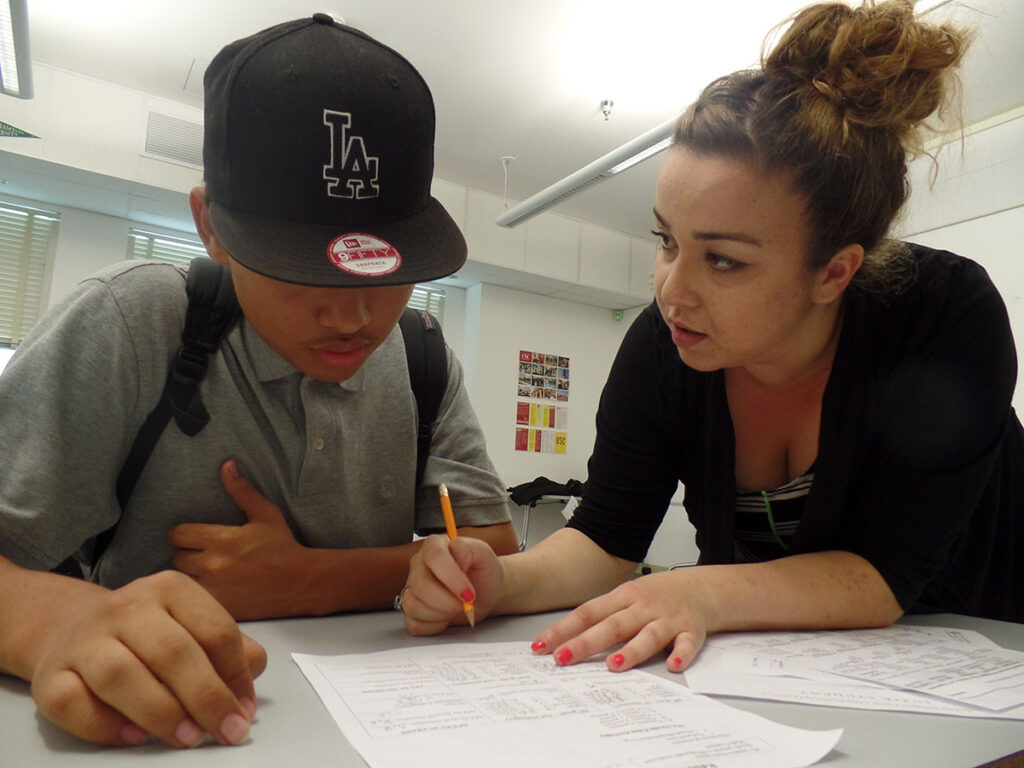

A teacher helps a student with a math problem.
Credit: Sarah Tully /EdSource
Top Takeaways
- District leaders rank math third, far behind literacy and social emotional learning, as priorities.
- Math lacks dedicated state funding for professional development, and training in most districts is voluntary.
- The gap between students from the highest and lowest-income California districts grew to 2.7 grade levels in 2024.
State leaders’ recent attention to early literacy has led to funding and new programs to help close the literacy achievement gap.
But math? The state hasn’t focused on it. And that neglect shows. State and national scores reflect many of California’s systemic weaknesses, according to a paper that is part of the sweeping research project, Getting Down to Facts.
How bad is it? The gap in math achievement between the highest and lowest income students in California grew from an already alarming 1.9 grade levels in 2009 to 2.7 grade levels in 2024, a 40% increase, according to calculations by Stanford professor Sean Reardon, director of the Stanford Education Data Archive. That means the highest-income students are nearly three grade levels ahead in math compared to the lowest-income students.
Gaps in reading, while also very wide, narrowed 5% over that time period. A third of eighth graders were proficient in math on the 2025 Smarter Balanced Assessments. The gaps among racial and ethnic groups have grown as well.
Significantly raising California students’ math achievement will require addressing compounding problems. The research brief titled “Mathematics in California: Gaps, Capacity and Implementation, by Elizabeth Huffaker, a doctoral candidate at the Stanford Graduate School of Education, outlines the issues:
Districts de-prioritize math. While 63% of California districts ranked English language arts as their top priority, only 16% ranked math first, with math trailing both English language arts and social-emotional learning.
Disparities in hiring. Highest-need districts encounter the most difficulty hiring and retaining math teachers.
Little math training. Most teachers credentialed to teach elementary grades receive little training in math during their 15-month post-graduate preparation program. Once hired, many teachers continue to receive little further professional development. One in five districts offered no consistent math training in 2024-25, and most existing professional development opportunities were voluntary. The result is that teachers lacking confidence or interest in math are less likely to attend optional training sessions.
Many districts are ignoring the state’s new math framework. In 2023, the state board adopted a new and controversial math framework that provides a grade-by-grade guide for implementing the state’s math standards. But many districts aren’t deploying it or instructing teachers on how to use it. Only one quarter of district leaders say the framework drives their math lessons, and 30 percent say it is not a driver at all.
School leaders cite the framework’s 900-page length as one obstacle. Others cite its emphasis on teaching the concepts behind math procedures. As one leader explained, “Many of our elementary teachers do not have deep content knowledge in math, which makes it difficult to teach conceptually.”
Another said, “Sometimes we design for maybe the top 10% of teachers who really can do this. Meanwhile, there’s 90% of teachers who are just like, ‘I don’t know what you’re talking about.’”
Too many curricula to choose from. The State Board recently approved 64 math textbooks and materials, based on reviewers’ findings that they all align with the state standards, without offering districts further guidance. That left it up to districts, many of which lack the time or expertise, to vet the options. Compare that to the new early literacy law — the state will select a list of evidence-based literacy curricula and require districts to choose from what will likely be a much smaller list.
Math scores decline as students move through K-8. On the 2025 Smarter Balanced tests, 46% of students were proficient in math in third grade, and only 33% were proficient in eighth grade. Widening gaps by ethnicity followed the same pattern. The same pattern didn’t apply to reading scores.
“The first finding suggests that students who struggle in math in the early grades are often left behind and rarely catch up,” Huffaker wrote.
Less math limits future opportunities. The decline in math proficiency has limited students’ course-taking in high school and may have narrowed career opportunities. The percentage of students who took algebra in eighth grade has essentially collapsed over five years. In 2012-13, about 64% of eighth graders took algebra, coinciding with the implementation of the Common Core standards. By 2018-2019, just 19% of eighth graders took math. Many middle schools eliminated Algebra as an option.
Pushing back Algebra I to ninth grade for the majority of students made it more difficult for students to take advanced math, including Calculus, which is often required for STEM majors in college.
This is problematic, especially for those low-income, Black and Latino students whose schools are more likely to have limited Algebra availability but could have succeeded by taking the course. Although the math framework endorses middle school acceleration for some students, it doesn’t offer clear guidance on who qualifies for Algebra I, the brief noted.
Make math a state priority
Observing that math has not received the support that literacy received in California, Huffaker pointed to Alabama, which, like Mississippi in reading, made the largest gain in the nation on the 2024 National Assessment of Educational Progress, the federal exam that measures student achievement in core subjects, often referred to as the Nation’s Report Card. Alabama’s 2022 Numeracy Act established an Office of Mathematics Improvement, revised teacher preparation and hired a full-time math coach in every elementary school.
A year ago this month, it appeared that California was starting in the same direction. Gov. Gavin Newsom proposed $220 million in the state budget for hiring math coaches; the money appeared in Newsom’s May budget revision, then vanished in final budget negotiations, said Cole Samson, assistant superintendent of curriculum and instruction for the Kern County Superintendent of Schools.
But a $50 million budget over two years did survive for the first step, the Mathematics Professional Learning Project, which Samson has been leading over the past year. The project is a network of regional county offices of education and the university-led California Mathematics Project, creating a statewide system of support for districts’ math leaders and coaches.
“Now we have to follow through with the money to districts to get the coaches so that they can engage meaningfully in the learning,” Samson said. “We have so many young teachers in the system who should have access to a coach or a mentor, especially in the early grades, to help them build their own confidence with math and then how to teach math.”
Instead, the opposite is happening in districts that are making cuts; coaches are being reassigned to the classroom, Samson said.
Samson was on the educator advisory commission for the 2023 math framework commission and endorses its emphasis on developing students’ understanding of math concepts. “I am a full believer that teaching towards the big ideas will make a lot more sense for kids to interconnect math domains,” he said. “But that’s not a one day PD – it’s an ongoing experience.”
Huffaker said the point is not to replicate Alabama directly, “but that sustained state prioritization in mathematics can be built through linked policy, funding, and support structures.”
Marshall Tuck, a leader of the state’s literacy reforms as CEO of the nonprofit EdVoice, agreed. EdVoice is now co-sponsoring legislation to require an early-grade math screener to identify students struggling with math.
“We need a comprehensive strategy for math,” he said.
Unsorted,California math framework,Cole Samson,Getting Down To Facts#California #double #attention #math #researchers1778660176

