

 wellnessfitpro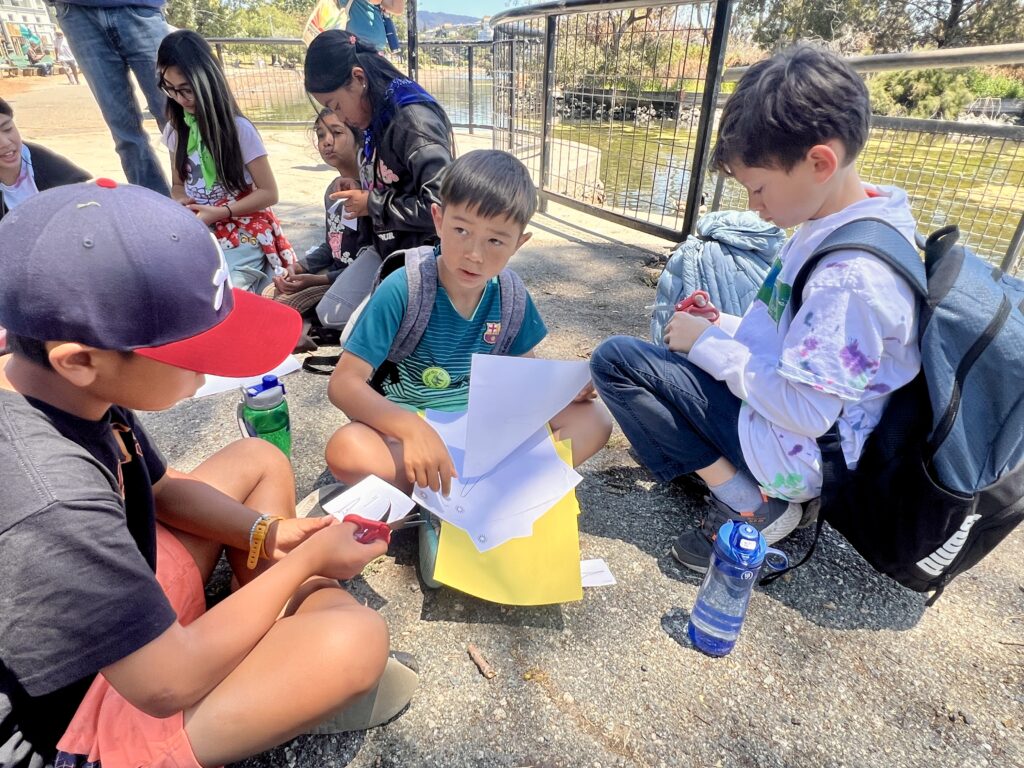

Richmond students enrolled in the Headwaters Science Institute’s summer program make cutout paper models of birds on the banks of Lake Merritt in Oakland.
Credit: Louis Freedberg / EdSource
Each Earth Day brings up big questions about the planet’s future: how will we improve our environment, protect ecosystems and accelerate innovation? The conversation often centers on policy and technology.
But we rarely ask a more fundamental question: are we preparing the next generation to solve problems that don’t fit neatly into any one field of science?
The defining challenges of our time — climate change, biodiversity loss, water scarcity, public health — are not biology problems or physics problems or earth science problems. They are all of these at once. Preparing the leaders and innovators of tomorrow requires more than acquiring discrete scientific facts — it requires learning to connect ideas across disciplines, and to understand complex systems the same way scientists do in the real world.
That kind of thinking doesn’t begin in graduate school or at a research lab. It begins much earlier, often in an unexpected place: middle school science classrooms.
Middle school is a critical time for students to develop their emerging interests and strengthen their identity as people who can do science. Schools can either reinforce the misconception that science exists in separate silos — teaching biology one year, chemistry the next — or adopt an integrated approach that more accurately reflects how science is practiced: integrated, collaborative and grounded in real-world questions.
National standards stop short of prescribing an integrated middle school sequence, but they clearly lay the groundwork for one. The Next Generation Science Standards organize learning expectations across a sixth–eighth grade band rather than assigning them year by year. In doing so, they emphasize explaining real-world phenomena and encourage connections across life, physical, and earth and space science through shared core ideas and crosscutting concepts. Many states have moved from that flexibility to explicit design: Texas and Ohio expect students to engage all three domains each year, while California’s preferred model for grades six–eight “interweaves science disciplines,” and was judged by the state’s expert panel to be the most effective approach for student learning.
This reflects a simple reality: the most consequential questions students encounter — about weather, water, energy, ecosystems and human systems — do not arrive sorted into disciplinary silos. When students study every domain every year, they are better equipped to make sense of complex phenomena in the world they actually inhabit.
The shift toward integrated, multidisciplinary science instruction is already well underway.
Middle school is a critical time for students to develop their emerging interests and strengthen their identity as people who can do science.
A new analysis from NWEA (Northwest Evaluation Association) found that across nearly 2,200 middle schools nationwide including 34 schools in California, 83% offer multidiscipline science courses, and another 14% offer a mix of integrated and single-discipline options. In some cases, discipline-specific courses appear to serve as enrichment — offering more in-depth study for advanced learners, much like the increasing specialization seen in higher education. Yet even there, the most challenging scientific problems demand collaboration across fields, and all students benefit from opportunities to think across disciplines. In that context, it is notable that enrollment in single-discipline courses remains relatively rare. Instruction that cuts across domains is no longer an alternative model — it is becoming the norm.
This matters because it more closely reflects how science actually works. At a time when challenges like climate change, public health emergencies and sustainability refuse to stay within disciplinary boundaries, today’s middle school science classrooms are quietly preparing students to think across domains, work together and apply knowledge flexibly. That preparation is a reason for optimism this Earth Day.
But realizing the full promise of this shift will require sustained attention not only to what students learn, but to how we support the systems that make this learning possible.
At the state level, this means elevating science education to a level of importance comparable to English language arts, literacy and math. California is setting an example by including science assessments in the statewide school dashboard, forging a path toward greater emphasis on science in the early grades. But a dashboard alone isn’t enough to drive this shift.
Teachers need strong instructional materials and meaningful professional learning opportunities that help them connect concepts across disciplines with confidence. In addition to supporting more intentional integration across the sciences, greater integration between science and other subjects like literacy can align how students investigate phenomena with how they read, write and reason about the world. Investing in these conditions is ultimately an investment in the next generation of thinkers who will need to work across disciplines to understand and respond to an increasingly complex world. This Earth Day, the conversation shouldn’t stop at what solutions we need, but how we prepare the people who will create them — because the future’s most urgent challenges won’t be solved by one discipline, and today’s classrooms can help show the way forward.
•••
Naomi Duran is a research scientist at NWEA, focused on examining neighborhoods, schools and equity in access to educational opportunities. Susan Kowalski is a former high school educator and a lead research scientist at NWEA, focused on the intersection of educational policy and science instruction in the U.S.
The opinions expressed in this commentary represent those of the author. EdSource welcomes commentaries representing diverse points of view. If you would like to submit a commentary, please review our guidelines and contact us.
Unsorted,California School Dashboard,Climate change,NWEA,Science#Preparing #generation #tackle #complex #environmental #challenges1776879310

