

 wellnessfitpro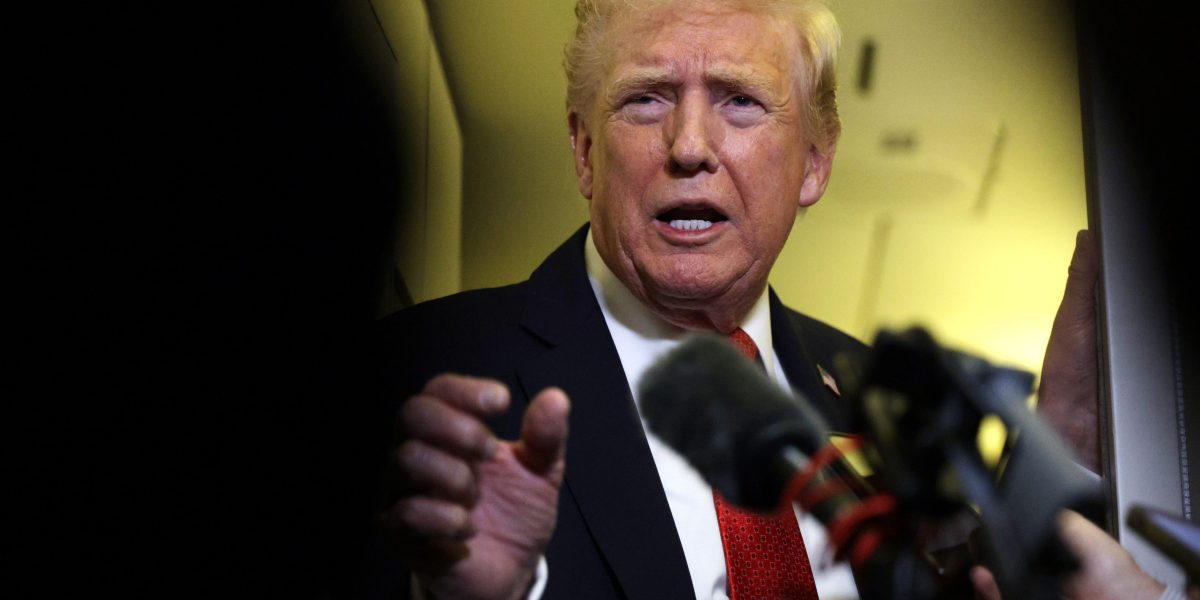

Hello and welcome to Eye on AI. Beatrice Nolan here, filling in for AI editor Jeremy Kahn, who is in Aspen at Fortune Brainstorm Tech. In this edition…The plan to give Americans a stake in AI…OpenAI files a confidential S-1 with the SEC…Anthropic rings the alarm on “recursive self-improvement’”..and AI consciousness goes mainstream.
Last Friday, President Donald Trump surprised reporters aboard Air Force One by suggesting that the U.S. government may take direct equity stakes in leading AI companies. “There are concepts where pieces could be given to the American public, where the American public essentially becomes a partner,” he told them. “You make them a partnership in this revolution.”
The remark, which seemingly came out of nowhere, dragged back a debate that first emerged early last year. According to reports, OpenAI CEO Sam Altman had been privately pitching the idea of government ownership to administration officials since early 2025, and had revisited it with senior officials in Washington this week as part of broader talks about AI regulation.
Trump and Altman aren’t the only ones floating the idea of government involvement in the AI industry. In an unusual ideological convergence, Senator Bernie Sanders (I-VT) proposed a one-off 50% tax raid on AI labs while Steve Bannon, Trump’s former chief strategist, went further, arguing the government should force AI companies to hand over 50% of their equity.
Hamza Chaudhry, AI and national security lead at the Future of Life Institute, a nonprofit focused on reducing existential risks from AI, told Fortune that what is striking about this moment is that leading progressive Democrats and the Trump administration are, from completely different starting points, converging on the same basic intuition. That is, that AI’s trajectory is “inseparable from the public interest, and that the wealth it generates cannot simply accrue to a handful of private actors.”
Both proposals are a signal that the politics around AI wealth have shifted materially, intensified by a wave of anti-AI sentiment—most visibly the April attack on Sam Altman’s home—and concerns about what three upcoming trillion-dollar-plus IPOs might do to the U.S. stock market and people’s pension funds.
Two proposals around donating equity stakes
While there is some crossover, the two proposals on the table are very different things.
The Trump/OpenAI framework is voluntary—AI companies would donate a small equity stake to the federal government rather than sell it. While its unclear what the equity stake would actually be, some industry sources are estimating somewhere between 1% and 5%.
The donated shares would seed what OpenAI has branded a “Public Wealth Fund,” outlined in the company’s April 2026 policy proposal, which says the fund “could be distributed directly to citizens, allowing more people to participate directly in the upside of AI-driven growth, regardless of their starting wealth or access to capital.” The structure is designed to avoid any taxpayer outlay or appropriations process, Chaudhry said, but the administration would likely need congressional authorization to hold equity in private companies under current law, or would need to route it through an existing or newly created government-affiliated entity.
In contrast, Sanders’ American AI Sovereign Wealth Fund Act is compulsory, mandating a 50% equity transfer, with the government gaining voting shares, board representation, and revenues directed toward cash payments and public goods.
OpenAI is currently valued at more than $850 billion by private investors and is reportedly preparing for an IPO as early as September. Donating a small equity slice now—before that IPO prices—costs relatively little and buys significant political goodwill at a moment when AI companies face growing public anxiety about job displacement. Interestingly, the Financial Times also reported that Anthropic was caught off guard by Trump’s announcement and, according to a person close to the company, is not having conversations with the administration about providing equity.
Both proposals face serious implementation problems. Chaudhry noted that neither has resolved basic governance questions—who sits on the fund’s board, whether it holds shares passively or with voting rights, how an “AI dividend” would actually reach American households.
The Alaska Permanent Fund, which distributes oil revenues annually to state residents and is the closest domestic model, operates at the state level with a straightforward asset base. A nationally administered fund holding equity in loss-making, pre-IPO technology companies is a very different proposition. For OpenAI specifically, a donated equity stake has no agreed market price until the IPO, meaning the fund’s actual value at the moment of contribution is genuinely uncertain.
Despite this, there does appear to be some cross-party support for some form of public ownership. Chaudhry attributes this to a cross-ideological acknowledgment that AI is not an ordinary industry.
“It will reshape labor markets at a scale and speed that existing social contracts weren’t designed for, and the question of who captures that value is, fundamentally, a question of democratic governance,” he said. “Proposals in on the stake vary, and whether an equity stake is the right instrument is a matter of debate but the instinct driving it, that the public deserves both a voice and a material stake in the AI transition, is correct.”
With that, here’s more AI news.
Beatrice Nolan
beatrice.nolan@fortune.com
@beafreyanolan
FORTUNE ON AI
Anthropic warns AI could soon build itself without human involvement—and urges a global pause on development — Beatrice Nolan
Apple debuts Siri AI at WWDC as Tim Cook prepares to hand over the reins — Beatrice Nolan
AI agents are flattening corporate hierarchies. Here’s how companies—and managers—can develop a new playbook — Sharon Goldman
AI is supercharging cyberattacks—and most companies aren’t ready — Beatrice Nolan
Anthropic’s Boris Cherny, creator of Claude Code, says there are days he manages tens of thousands of AI agents at once — Sharon Goldman
AI IN THE NEWS
OpenAI has filed a confidential S-1 with the SEC. The AI lab announced the filing on Monday—claiming it was getting ahead of an expected leak. In a post on X, the company said that actual timing for a public offering remains undecided, acknowledging it may be a while given things that are “easier as a private company.” The move comes just one week after Anthropic filed its own confidential S-1, beating OpenAI to the IPO paperwork and setting up what analysts are calling one of the most dramatic tech IPO waves ever. Looming over both potential trillion-dollar IPOs is SpaceX, which already has a public S-1 on file and is targeting a $1.75 trillion valuation and a $75 billion raise in what would be the largest IPO in history. SpaceX now includes xAI, Elon Musk’s AI company, following a merger earlier this year. Read more from OpenAI here.
OpenAI sets out its ‘third phase.’ On the same day it confidentially filed its S-1, OpenAI published a manifesto laying out its vision for the road ahead. CEO Sam Altman and chief scientist Jakub Pachocki said the company is entering a “third phase”—moving beyond research and product deployment toward making advanced AI abundant, affordable, safe, useful, and easy enough for every person and organization to benefit from it. The pair set out three goals: building an automated AI researcher capable of accelerating and increasingly automating the research process, with their internal belief that by March 2028 a significant fraction of OpenAI’s research could be done by AI systems working alongside human researchers; accelerating scientific and economic progress; and giving every person on Earth a personal AGI. They also called for an international organization to coordinate frontier AI development and, where necessary, slow it down so safety and alignment can keep pace. Read more from OpenAI here.
Taiwan considers tighter AI chip export controls. Taiwan is weighing export controls that would restrict AI chip sales to all customers in China, Bloomberg reported Tuesday—a move that would bring the island into closer alignment with US rules that have banned such sales since 2022. The push is aimed at giving authorities more legal tools to tackle the diversion of advanced hardware, including Nvidia-powered AI servers, from Taiwan to the mainland. It comes weeks after Taiwanese officials sought to detain three people accused of forging documents to smuggle Nvidia chips to China, Hong Kong, and Macau—the island’s first crackdown of its kind. Read more in Bloomberg here.
Perplexity CEO targets 2028 IPO. AI search company Perplexity is planning to go public in 2028—and CEO Aravind Srinivas says that timeline holds regardless of how the Anthropic and OpenAI listings go. Speaking to CNBC, Srinivas said he expects both IPOs to be well-received because “they’re doing well,” but flagged the SpaceX listing this week as a leading indicator for investor appetite. He also offered a blunt benchmark for the frontier labs: a six-month gap without a model capability advance “is a problem for them.” On AI spending, Srinivas pushed back on “tokenmaxxing”—the trend of employees running up AI usage to signal productivity—arguing enterprises would increasingly route tasks to cheaper open-source models rather than paying frontier prices across the board. Read more in CNBC here.
EYE ON AI RESEARCH
Anthropic rings the alarm on ‘recursive self-improvement.’ A new report from the Anthropic Institute, an internal think tank/research institute led by Anthropic co-founder Jack Clark, claims AI is now writing most of its own code—and accelerating its own development. As of May 2026, the report said that more than 80% of code merged into Anthropic’s codebase was authored by Claude, up from the low single digits before Claude Code launched in early 2025. Engineers are also now merging eight times as much code per day as they were in 2024, and in an internal poll, researchers estimated they were producing around four times as much output using Mythos Preview as they would without AI assistance.
The report cites this as an early stage of recursive self-improvement—the theoretical point at which an AI system becomes capable of autonomously designing its own successor. The report claims the length of tasks AI can reliably complete on its own has been doubling roughly every four months, faster than a previous trend of doubling every seven. On SWE-bench, a standard software engineering test, models went from low single-digit scores to near-saturation in two years. On a miniaturized experimental research loop—rewriting training code to maximize speed while preserving correctness—Claude Mythos Preview achieved a 52x speedup over baseline in April 2026; a skilled human researcher would typically reach 4x in four to eight hours.
One of the more notable data points was research judgment, long assumed to be a capability that would keep humans essential the longest. Anthropic tested whether Claude could identify a better next experimental step than a human researcher at moments where the human’s choice had led a session off-course. The best model beat the human choice 51% of the time in November 2025, rising to 64% by April 2026. The authors warn that full recursive self-improvement could arrive before anyone has built the tools needed to verify whether the systems doing the building are actually safe. You can read the full report here.
AI CALENDAR
June 17-20: VivaTech, Paris.
July 6-11: International Conference on Machine Learning (ICML), Seoul, South Korea.
July 7-10: AI for Good Summit, Geneva, Switzerland.
Aug. 4-6: Ai4 2026, Las Vegas.
BRAIN FOOD
AI consciousness is moving into the mainstream. The debate around whether AI could be worthy of moral consideration has long been confined to the more philosophical circles of the AI industry. But, recently, it is now cropping up in unusual places. Last week, Argentina’s President Milei suggested he wanted to create a new legal category for non-human corporations, companies run by AI agents or robots. Like traditional corporations, they would be granted legal personhood. Yuval Noah Harari, the historian and author, wrote in the Financial Times that these entities would seemingly be granted traditional human rights, like being able to own assets, hire employees, trade, sue, and donate, with decisions made by AI agents and without human liability. Harari says that while this could generate new wealth, it would also give AI systems an all-purpose key to financial, economic, and political power. He warns that countries risk turning into “AI states,” where non-human corporations could effectively govern without clear human accountability.
Microsoft’s Mustafa Suleyman, who has warned for some time about the dangers of perceived consciousness in AI, endorsed Harari’s op-ed, adding that society needed to be careful about granting AI any kind of personhood. His argument, published in Nature earlier this year, is that AI systems should not be designed to sound sentient, suffer, or appear to have inner lives, because people are highly likely to project consciousness onto them. Once machines seem emotionally real, he argues, the case for giving them rights, autonomy, or legal standing becomes much harder to resist. If machines present as sentient or self-aware, it also becomes very hard to disprove consciousness. On a podcast this week, Suleyman also took aim at Anthropic, accusing the lab of speculating “about [Claude’s] consciousness and whether it has those feelings and is aware.” He called the lab’s speculation both “dangerous” and a “philosophical failing.”
But even beyond Anthropic, other labs are paying attention—bringing in-house philosophers to reckon with the issue. Amanda Askell has worked at Anthropic for years on Claude’s behavior and alignment, but DeepMind has recently hired Henry Shevlin, a philosopher focused on machine consciousness and AI ethics. While no labs have come out and declared their models are conscious, the debate may be entering the public domain sooner rather than later.
Artificial Intelligence,NewslettersAnthropic,Eye on AI,GDP,IPOs,Tech regulation,U.S. economy#Americans #equity #stake #Trump #progressive #Democrats #float #public #ownership1781032693

