

 wellnessfitpro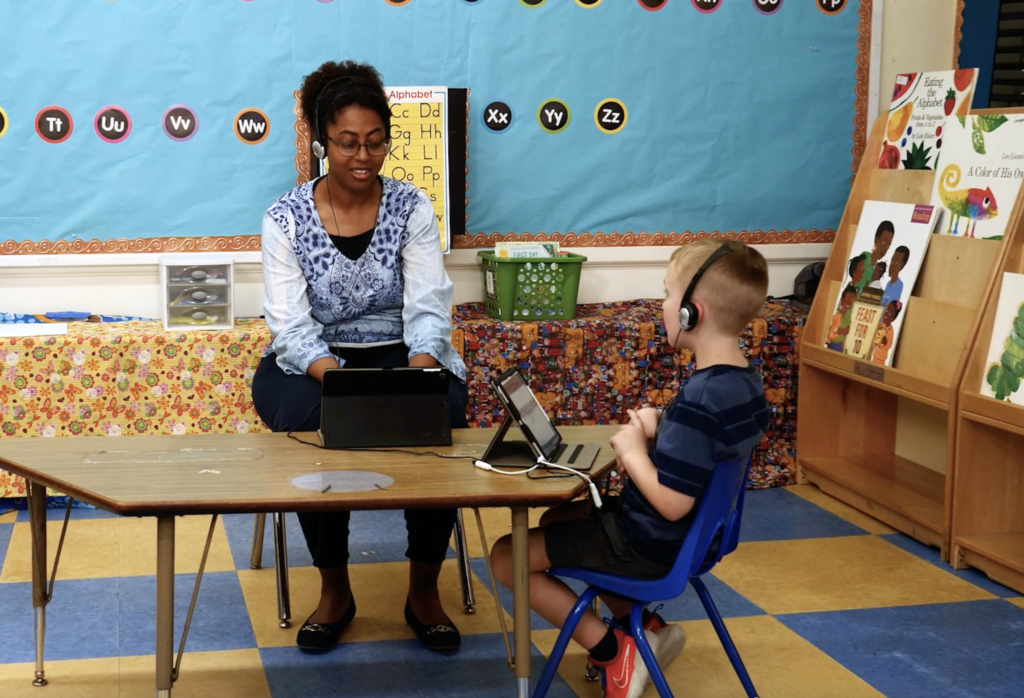

The Multitudes screener is administered 1-1 by an educator to a student, with paired devices.
Credit: Courtesy of UCSF Dyslexia Center
Top Takeaways
- Gov. Gavin Newsom wants schools to wait to screen children for reading difficulties until mid-school year.
- Proponents say a waiting period ensures children have enough instruction in English and in reading skills.
- Some literacy advocates are worried children won’t get the intervention they need.
California began screening all students in kindergarten through second grade this school year to determine whether they are at risk of developing reading difficulties, such as dyslexia, after Gov. Gavin Newsom signed a landmark bill into law in 2023.
The screenings are part of a set of policies that aim to raise the number of California third graders reading at grade level — 56% of whom fell short this academic year — by reimagining how kids are taught to read.
Now, the governor seeks to make more changes that have divided the state’s experts and advocates. He has introduced legislation to require schools to wait until the 91st day of school to screen kindergartners, and until the 46th day of school to screen first and second graders.
Proponents of the waiting period say it’s necessary to ensure children have had enough instruction in foundational reading skills and English before testing whether those skills have soaked in.
But the proposal has some literacy and dyslexia advocates and researchers worried that California is backpedaling on a hard-won effort to catch kids early on who need extra help with reading.
Why the State Board of Education proposed the change
The governor’s office proposed the waiting period based on recommendations from the State Board of Education, which collected data from the first year of screening.
The original law states that schools should consider whether students have acquired enough formal instruction in foundational literacy skills and English proficiency before screening. However, it did not give a timeline, leaving the decision of when to screen up to school districts.
According to a Public Policy Institute of California (PPIC) survey of school districts conducted in December, a fifth of districts screened kindergartners only once at the beginning of the school year.
“California field data from more than 1 million students show that when screening occurs in the first weeks of school, up to 60% of kindergartners and about half of first and second graders may be flagged ‘at risk,’ ” said Alex Traverso, director of communications for the California State Board of Education. “As students receive instruction, those numbers drop sharply, showing that many students were simply new to formal reading instruction, not likely to have a persistent reading difficulty.”
According to a memo from the state board, the percentage of students flagged as “at risk” dropped to about 20% in January.
Traverso clarified that under the proposal, schools could still screen students at the beginning of the school year, as long as that screening was not used to determine risk of reading difficulty.
Why some advocates and researchers are alarmed
The proposed waiting period alarmed some literacy advocacy organizations — including Decoding Dyslexia, California Literacy Coalition, Families in Schools and EdVoice — that had advocated for years for the first screening bill.
Kareem Weaver, executive director of the Oakland-based literacy advocacy group FULCRUM, opposes delaying the screenings. He told lawmakers at an April 8 Assembly hearing that if children’s reading skills improve after receiving instruction, it’s a sign the screenings are working.
“It was intended so that we would not wait for kids to fail. We would catch them on the front end and help them … and that’s exactly what’s happened,” Weaver said. “That’s not a bad thing. That’s a good thing.”
Megan Potente, state director of Decoding Dyslexia CA, said if schools have to wait to screen kids, “the window of opportunity shortens” to provide intervention.
“It does feel a little bit like backtracking, because California just made this commitment. We are definitely OK with adjustments to reflect evidence, but it’s just far too soon to be restrictive in this way,” Potente said.
She added that if Newsom’s legislation passes, California would be the only state with restrictions on screening for first and second grades.
Young-Suk Kim, a UC Irvine professor who chaired the committee that selected the screeners, said the idea of imposing a waiting period is misguided because it conflates the screening results with a diagnosis of dyslexia. Instead, she said the goal of the screeners is to learn what each child needs, so that teachers can tailor instruction.
Kim said kindergarten teachers should know from the very beginning of the school year whether students know letter names and sounds, “rather than waiting for 92 days and just providing instruction blindly.”
“That’s just shooting in the air, hoping that it’s going to hit the mark. That will hit the mark for some kids, but you’re likely to miss a lot of kids’ needs,” she said.
In addition, Kim said it’s much better if schools have data at the beginning of the year so they can compare it with data from winter or spring. If one group of children does better by winter and another does not, the second group may need more intervention.
Other researchers approved the move
Dr. Marilu Gorno Tempini, professor of neurology and psychiatry and director of the UCSF Dyslexia Center, who helped develop one of the screeners, Multitudes, said she agrees that screening students multiple times during the year and comparing results can be helpful. But if schools can only screen students once during the year, a waiting period makes sense.
“Very early in kindergarten, the results of a screener … can be considered a benchmark, but it cannot be considered a true risk of future reading difficulties because many kids have not acquired enough language yet, or haven’t had enough experience in testing or being in school,” Gorno Tempini said.
The waiting period was welcomed by English learner advocacy organizations, which have long raised concerns that students who speak languages other than English could be flagged for reading difficulties simply because they do not understand English.
“The fact that 60% of children are being identified as at risk to me is a red flag. I do feel like that’s enough to say that that’s not what the legislation was intending,” said Martha Martinez, director of research and evaluation at the nonprofit SEAL and a member of the committee that selected the screeners.
Districts still need more clarity about when and how to screen English learners, said Monica Aguirre, an English language arts coordinator at the San Diego County Office of Education. Current law says students who are not proficient in English should not be screened in English, but it does not make clear how schools should measure proficiency.
“If I threw you into a classroom of a language that you didn’t know, and I screened you in that language within the first 30 days, would you be able to show that you’re not at risk for a reading difficulty in that language?” Aguirre said.
The PPIC survey found that it was more common for schools with more English learners and low-income students to only screen once at the beginning of the school year. If a child is flagged as at risk, schools are supposed to provide support, such as small group instruction to learn the sounds letters make.
“That may be exactly what a kid needs, who is really struggling to develop their reading skills, but that’s not a perfect use of time for all kids,” said Sarah Novicoff, research fellow at PPIC. “There are kids who do not need that intensive instruction and would probably be better off in their classroom with their peers.”
She recommended that the state encourage schools to screen students multiple times a year, but if they can only screen once, it should be later in the year.
Unsorted,Decoding Dyslexia CA,dyslexia,EdVoice,Multitudes,Reading,San Diego County Office of Education,science of reading,SEAL,State Board of Education,UCSF#Newsoms #push #change #kids #screened #reading #difficulties #divided #experts1779928385

