

 wellnessfitpro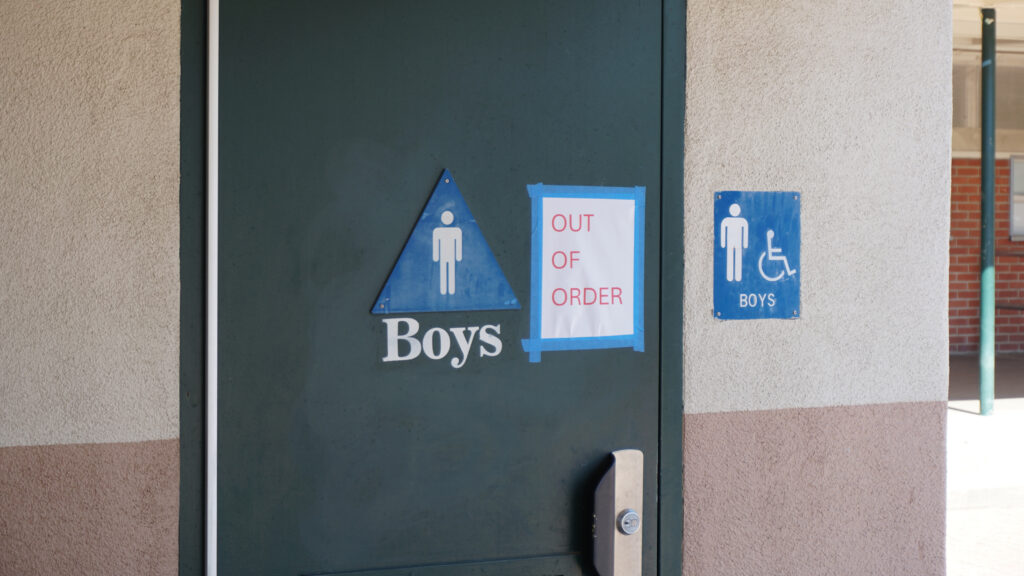

An out-of-order bathroom at El Camino Fundamental High School in San Juan Unified in Sacramento County in 2024.
Credit: Andrew Reed / EdSource
Top Takeaways
- At issue is whether districts with more property wealth per student receive a greater share of matching funds for school renovations.
- Plaintiffs worry that funding from a voter-passed state bond will run dry by the time a verdict is reached; the state argues the plaintiffs failed to justify an injunction.
- Judge Patrick McKinney said the facilities lawsuit could win on merits, but he’s concerned about halting funds for school modernization before the trial.
Attorneys pitched their arguments this week to an Alameda County Superior Court judge who acknowledged he was torn about whether to temporarily stop billions of dollars of school construction grants that plaintiffs charge discriminate against low-wealth districts.
“I’m almost right down the middle on this right now,” Judge Patrick McKinney said Wednesday during a 90-minute hearing. “We’ll see which way this goes today.”
McKinney issued no decision and didn’t say when he would rule on the motion to halt the $4 billion state program to modernize schools.
In October, 14 students, parents and teachers from low property-wealth districts, plus three local nonprofit organizations, filed Rodriguez v. the State of California and the state agencies that oversee school facilities operations.
Their lawsuit alleges that the state’s school facilities modernization program favors property-wealthy school districts. It said their bigger tax bases enable them to issue larger construction bonds, often at lower tax rates, setting them up for the lion’s share of scarce state matching funds. The plaintiffs live in eight districts, including Salinas City Elementary School District, Lynbrook Unified in Los Angeles County, San Bernardino City Unified, Stockton Unified, Calexico Unified in Imperial County and Coachella Valley Unified in Riverside County.
In March, their attorneys filed for a temporary injunction to stop the California Office of Public School Construction and the State Allocation Board from issuing more grants from the $4 billion school modernization program. Its funding is included in a $10 billion school construction bond, Proposition 2, that state voters passed in 2024.
The plaintiffs cited the risk that there’d be no money left by the time their lawsuit is decided in their favor — perhaps years from now — and the state is ordered to create a new and equitable allocation system.
“This is a case about children who are being denied their equal educational opportunity because they live in low-income communities, and this case is about this finite pool of voter-approved money that is being drained before the court can address that inequality,” plaintiff attorney Matthew Stephens told McKinney.
Stephens is an attorney with the Morrison and Foerster law firm, which filed the lawsuit with the public advocacy law firm Public Advocates. He acknowledged that requesting a pretrial injunction would be “a significant ask,” requiring a double burden of proof. Attorneys must persuade a judge that not only would the lawsuit likely succeed on its merits, but also that the plaintiffs’ immediate benefits of stopping the program would outweigh the potential harm of withholding funding from schools awaiting renovations and repairs.
“A pause would allow sufficient time for a new funding system” to provide schools fair access to modernize, he said.
Two sides of the argument
In sharing his thinking with attorneys at the start of the hearing, McKinney, who said he had read the extensive briefs, gave the plaintiffs cause for optimism.
“I think there’s been some demonstration of success on the merits. It’s certainly possible plans will succeed,” he said.
But then he added, “The one thing I’m really struggling with here is that by stopping the funds from flowing, certainly worthy projects are going to not be funded, however long the stay remains in place, including projects from the less-wealthy districts.”
The plaintiffs have agreed not to contest $800 million in modernization funding for projects already approved by the State Allocations Board, and funding for the next round is under review. Under the program, districts can apply to renovate school buildings 25 years or older and replace portable classrooms more than 20 years old. The state funds 60% of the cost based on the number of students enrolled in a building, and school districts pay 40%.
That would leave 174 districts with 566 school projects whose funding would be in jeopardy, said State Deputy Attorney General Joshua Sondheimer. An injunction could affect $400 million set aside for smaller districts, although the plaintiffs assert a high proportion of those are also property-wealthy districts.
The plaintiffs’ lawsuit cited research from the Center for Cities + Schools at UC Berkeley, which found that modernization funding per student for the wealthiest districts was 2 ½ times what the poorest property districts received from 1998, when the program was created, through 2023. The pattern has continued for the first rounds of funding under the latest state bond, the center said.
But Sondheimer claimed there would be little wealth disparity among districts eligible for the remaining unfunded projects. And one of the districts cited in the lawsuit, San Bernardino City Unified, is on the list, and would be adversely affected by a delay.
To which Stephens responded, “Our position is that if a more equitable funding distribution was in place, those districts should be getting more.” And districts that have been shut out of the program, because they couldn’t raise enough money for the match or were put off by a cumbersome process for applying for restrictive hardship assistance, also would receive more funding.
Sondheimer asserted that the plaintiffs failed to establish that they had been irreparably harmed by the modernization requirements. Their evidence is anecdotal, and their claims of poor facility conditions in individual schools don’t prove a wider problem.
“If they’re making a claim that is districtwide, you need to consider the conditions of all the schools, not simply the one school that has an AC system that’s not working,” he said.
Other sources of funding, too
In addition, Sondheimer said, it’s important to place the modernization program in the broader context of other sources of facilities funding: matching funds through the state’s new construction program, the billions of dollars of federal Covid relief for updating HVAC systems, and the state’s facility hardship program. Combine all, he said, and “it’s clear there is equity amongst the districts in receipt of facility funding.”
Stephens countered that these programs do not mitigate the failings and unfairness of the modernization program.
The state chose the rules preventing low-wealth districts from passing bonds even to qualify for modernization funding; the “human stakes are real,” he said.
“Children in Calexico attend schools where plumbing failures have forced closure in all but one restroom in one school. High school students in Lynwood cannot perform basic chemistry and physics experiments because their schools lack Bunsen burners, chemical showers, eye wash stations and ventilation hoods.” And children in Coachella sit in classrooms where, with faulty air conditioning, learning drops as inside temperatures climb to 85 degrees.
They need funding now, “because once funds from Proposition 2 are exhausted, they’re not coming back,” and “there’s no guarantee” if or when voters will approve the next state bond, Stephens said.
Unsorted,Center for Cities + Schools,Office of Public School Construction,Public Advocates,Rodriguez v. California#decide #judge #temporarily #halt #state #grants #school #renovations1780101742

