

 wellnessfitpro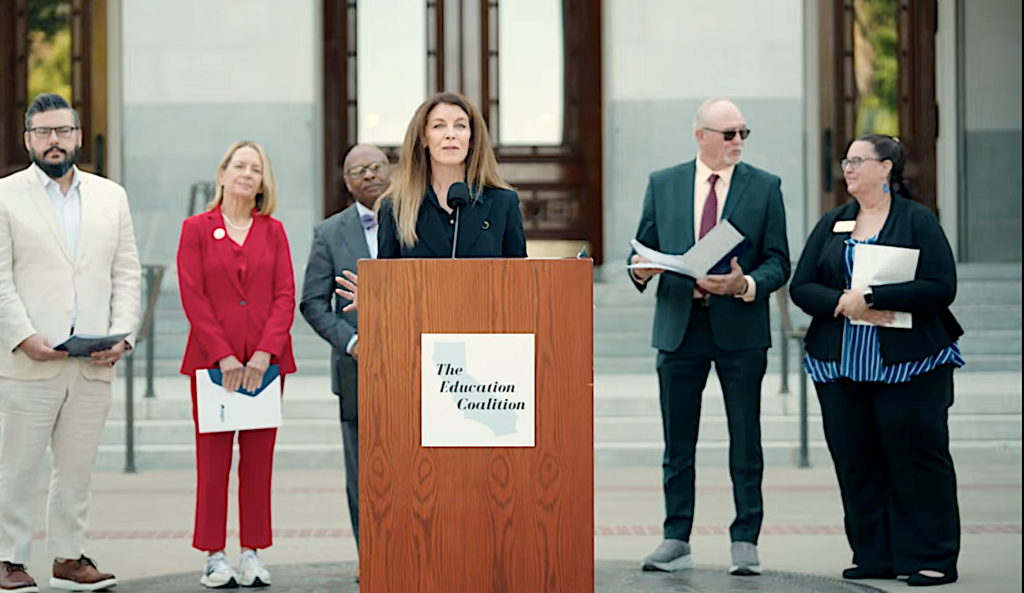

Tatia Davenport, CEO of the California Association of School Business Officers, calls for inclusion of $3.9 billon in the 2026-27 funding for schools and community colleges during a press conference May 21 at the State House.
Top Takeaways
- School districts argue recent forecasts have lowballed revenues by billions of dollars.
- Gov. Gavin Newsom says the state would be in a bind if the Legislature overestimates what’s actually owned.
- Districts are suspicious about when they’d get the money if revenues do come in as predicted; repayment could take years.
In coming days, school districts will find out whether their pressure campaign worked to persuade Gov. Gavin Newsom to turn over the $3.9 billion he planned to withhold, for now, from next year’s state funding for schools and community colleges.
By midnight Monday, June 15, the state Legislature must pass a balanced state budget; legislators and the governor have been negotiating how big it will be and what’s in it.
The $3.9 billion in question is about $684 per student, depending on how it’s distributed; at a time of declining enrollment and rising expenses, districts say they need the money now, not later.
Newsom says districts will get it after projected revenue turns into actual cash in hand by early next year, after more revenue is collected. Until then, it’s wise to be cautious, Department of Finance officials warn.
At issue is how much funding will increase under Proposition 98, the 1988 formula guaranteeing that schools and community colleges receive about 40% of revenue from the state’s general fund. Newsom is projecting that the 2026-27 Prop. 98 guarantee would be a record $127.1 billion.
But state budget forecasters and the nonpartisan Legislative Analyst’s Office are also hedging their bets, saying that the projection could come up short, and growth may slow or even recede. The question is not if the current boom cycle fueled by AI investments will slow, but when, they say.
Education advocacy groups disagree with the governor’s approach. With rare unanimity, a coalition of school employee unions and groups representing school boards, school administrators, business officers, charter schools and parents have reacted with anger and indignation, and their members flooded the halls of the Legislature last month to lobby legislators to insert the $3.9 billion into the final budget.
“It’s not just $3.9 billion, even though that’s a tremendous amount of money, what we’re confronting is an existential threat to the way that we fund public schools here in California,” Troy Flint, chief information officer of the California School Boards Association, said during a press conference outside the Statehouse on May 21.
“That is resources that our kids won’t have, and those are opportunities they will never receive. A dollar delayed is a dollar denied.”
Tatia Davenport, CEO of the California Association of School Business Officials, said, “Proposition 98 was passed in California by our voters to ensure that education funding could not be traded away during difficult budget years. Prop. 98 is unambiguous. It is a guarantee. It is the law. It is not a suggestion.”
And Erika Jones, an elementary school teacher who is secretary-treasurer of the California Teachers Association (CTA), added, “Prop. 98 is a minimum guarantee. As the fourth-largest economy in the world, California leadership should be striving to give students more than the bare minimum, let alone dipping into that minimum to cover budget shortfalls.”
“If state leadership cares about the future of California, they must stop diverting constitutionally guaranteed funding away from public schools, from fully funding,” she said.
The remarks are compelling but also somewhat misleading. As with much of the arcane details of state financing and especially Prop. 13, it’s always more complicated.
The unknowns behind the estimates
The revenues on which a state budget is based every June are tied to a multi-year forecast that can be substantially off. In the last several years, the forecasts have significantly underestimated the revenues. Newsom’s first pass in January at the budget for 2026-27 fiscal year starting July 1 included $21.7 billion more for Prop. 98 than the Legislature had budgeted for 2025-26 in June a year ago. All of this excess money will roll forward to 2026-27.
Then, in the May budget revision, with revenues for 2025-26 continuing to pour in, he upped the Prop. 98 forecast again. Newsom, who had proposed in January to withhold $5.6 billion, reduced it to $3.9 billion and used the difference to help fund a higher cost-of-living adjustment (COLA), add to the rainy day fund and increase money for special education.
A primary reason for soaring revenues is that, over the past few years, AI has been the state’s ATM. Unanticipated income and capital gains tax receipts from the state’s wealthiest taxpayers’ investments in artificial intelligence-related corporations are propelling state tax revenues.
And yet a lot is still unknown. Some corporate and individual taxpayers didn’t pay their 2025 taxes by April 15. Their late payments and previous estimated taxes may be substantially less than anticipated.
Lessons from the floods of ‘23
What Newsom wants to avoid is overcommitting to Prop. 98. That happened three years ago, following massive winter storms and flooding in late December 2022 and January 2023. In pushing back the filing date for 2022 taxes from April 15 to Nov. 16, 2023, for almost all counties, Newsom and the Legislature were left guessing at revenues when they passed the 2023-24 budget the previous June.
They guessed wrong and appropriated $8 billion more than Prop. 98 was entitled to. Rather than short schools and community colleges midway through the school year, Newsom and the Legislature, in effect, took out a short-term loan against the non-Prop. 98 side of the general fund, the portion of the state budget that covers private childcare, CSU and UC. It also includes areas, such as Medi-Cal, with the fastest rising rate of spending that are driving forecasts of budget deficits.
The Legislature is not likely to bail out schools again using this strategy if there’s another Prop. 98 shortfall.
The Legislative Analyst’s Office has studied how close the Legislature comes to annually estimating state revenue, and found it ran between 4% over or under projections, said Ken Kapphahn, LAO senior fiscal and policy analyst. Holding back $3.9 billion on a $127 billion Prop. 98 guarantee falls in that range.
No lock-solid timing of the settle-up
In his budget message, Newsom said that he would take another look at revenues early next year (actually, his successor will) and settle up the revenues then, as statutes require.
But there’s a catch: State law doesn’t state when the money must be repaid — in one year or over several. When education advocates use “gimmick” and “theft” of Prop. 98, they’re implying that Newsom and future governors might use Prop. 98 obligations as a piggy bank to shore up other parts of the budget.
Michael Fine, the CEO of the Fiscal Crisis and Management Assistant Team, the state agency that oversees financially troubled school districts, says he understands all the arguments.
“This is a difficult topic as I agree with both sides,” he wrote in an email. “I understand the risk the administration is hedging against and agree the risk is real, and I recognize the constraints placed in recent years on how to handle over-appropriations of Proposition 98 are problematic. I also fully understand and appreciate the argument around the intent of Proposition 98 being made by advocates.”
Since the May revision, three blockbuster AI corporations — SpaceX, Anthropic and OpenAI — announced they will go public with stock offerings in coming months, signaling billions more in taxable earnings in a frenzy of stock sales — or not, if they’re a bust. Unstable oil prices and rising inflation also complicate revenue projections.
The Ed Coalition can count on the Democratic majorities in the Senate and in the Assembly. Both have gone on record supporting restoring full funding in the final budget.
In their alternative proposal, Senate leaders would build back the $3.9 billion, and specify how to spend it:
- Raise the discretionary block grant by $1.5 billion
- Add to the rainy day fund by $1.2 billion
- Raise the grant program for career/technical education by $300 million
- Fund schools’ kitchen infrastructure by $900 million
Democratic leaders in the Assembly are vague about how to fund the $3.9 billion, but in the Assembly’s budget outline, they make their priority clear: “The Governor’s January proposal shortchanged schools by billions. The state constitution requires those dollars to flow — and they will.”
Under the state constitution, the Legislature must pass a state budget by June 15. If not then, certainly by June 30, there will be an answer to the $3.9 billion question.
Unsorted,2026-27 State Budget,Michael Fine,Proposition 98#California #school #districts #battle #billion #argue #due1781252351

